
I Know Why People Stay

Stay
I just started my third semester of an accelerated nursing program. (Woo hoo!  Only 32 LONG weeks to go…) During our orientation for Community Nursing, a local social worker came and did a short presentation on domestic violence, and the cycles that cause people to stay in or return to bad relationships.

It is an insidious cycle, that gains more momentum with each turn. Some type of abuse occurs, followed by a honeymoon stage, where the perpetrator tries to draw the victim back into a false sense of safety and acceptance with loving gestures, flowers, gifts…  Then, tension begins to build as the abuser’s dark side again begins to manifest itself, finally resulting in another abusive event.  This cycle continues and continues until the victim feels completely incapable of leaving the situation because of fear, manipulation, and sometimes the belief that they are at fault or must “save” their abuser.

During the orientation, the social worker offered us a short role role play, where an “abused” mother was handed heavy books representing all the difficult things she would face if she tried to leave the abusive relationship she was in.  Delayed court dates, struggle to find childcare, manipulation and intimidation by the abuser, lack of good community resources, lack of family support, potential for getting fired at work….the list went on and on until the role play volunteer was holding a hefty stack of heavy books in her arms, looking defeated herself.

I compared this role play to my own life. I didn’t leave my marriage because of blatant abuse, but so many of the outcomes of the role play still rang very true with me. It got me to thinking about how people in our culture view those who get divorced, why so many of us stay in bad marriages, and maybe how we should start reframing the whole divorce narrative.

First of all, I want to point out some things I’ve noticed about marriage and divorce, especially related to the “Christian” culture that still pervades much of our society and influences dynamics that occur within churches. I must preface by saying I’m throwing out some big generalizations, but I think there is truth in all of them, especially after the countless conversations I’ve shared about them with other people.

  • In many circles, marriage offers a step up in citizenship.  I noticed this shift personally both within my family and within churches that I attended.  Singles are given lip service, but the “sacrament” of marriage still carries so much weight that people are treated as though they are even just a bit more worthy, more capable of offering something to the outside world, if they are in a legally bound partnership. I can recall all the dumb books I read growing up that circulated among so many people I knew.  I Kissed Dating Goodbye, Lady in Waiting, and countless other dating and courtship treatises weighing down Christian bookstore shelves that taught us how to prepare ourselves for the ultimate initiation rite of marriage.  Looking back at them, it’s all quite nauseating to me.  We believed if we could just get to marriage, we would arrive…and in some cases, like mine, we did arrive. My status definitely improved in many ways.
  •  In the same way that marriage offers us a leg up, even in our modern culture, divorce causes us to take a step backwards.  Actually, I would venture to say even several steps backwards….even below where we were as virgin singles. Those who have been through a divorce get it, but so many who haven’t exude skepticism about our marriage commitment in the first place, or one’s connection to God, or one’s effort to make the marriage partner happy, or etc, etc.  I suspect this is partly why so many people rush back into marriage…partly out of loneliness, and partly because we want to be treated like whole, complete people again.
  • I’ve gone to so many conferences, retreats, and Christian counseling sessions where a another hefty pile, this time guilt, is handed to people struggling in their marriages.  You made a vow before God, you need to honor it. You decided to marry this person, now it’s for life.  Women, you need to respect your husbands. Women, it really only takes a few minutes…will it really kill you to give your husband what he wants? You’re just being selfish. Men, you were placed as the head of your household by Christ, you need to lead it properly.  And on, and on.  (And don’t even get me started on how the definition of rape needs to be broadly expanded within the institution of marriage….and the definition of nagging and hen-pecking for that matter.)  The bulk of these platitudes thrust on me, even by well-intended people, never helped me at all

All of this is to say: I think the main reason that good people stay in bad marriages is not because they are more committed people, or more God-fearing, or more sacrificial.  I think it’s because they are freaking scared of the alternative: a fall from status and alot of really hard things to sort out for an indefinite period of time.

I was chatting with a friend recently and told her, “This is the kind of day that makes people stay in bad marriages.”

You know, the kind of day when you can’t find a last minute babysitter, and you have a $2,000 leaky roof bill, and you can’t figure out how you’ll save for college on your own, and your kid is throwing up at school but you can’t leave what you’re doing to get him, and you have to board your dog for the day because otherwise you’ll come home to an accident on your already gross carpet, and you can’t go to the doctor for anything less than an antibiotic-resistant flesh-eating bacteria because you have a ridiculous deductible, and you can’t remember the last time you were hugged by an adult much less kissed or held by one, and you’re afraid you’re going to freaking go out of your mind trying to coparent with someone you don’t even recognize anymore, and you’re praying that your kids aren’t ingesting too many endocrine disruptors because of the crap you’re feeding them lately, and  you want to go out with your friends but based on your current schedule you can see that maybe happening next month…and..and..and…

This, friends, is why people stay in bad marriages. Because we aren’t taught that we can make it on our own, or that we have inside us what we need to survive.

Now, I should clarify, there are some marriages that really should be fought for.  But let’s just call a spade a spade and recognize that some broken marriages are necessary endings.  Necessary not always because of abuse or infidelity, but because the people in the marriages are suffocating and living out of motivations based in fear.  Which is not how ANYONE should be living.

This is how I lived for years.  Oh, I’d tell myself I was doing it for Jesus, but that was only superficially true.  I stayed because I was scared of regressing to my pre-marriage status, of pissing off God, of being judged by my family and the people around me, and of screwing my kids lives up forever.  And I know I’m not alone in this…I know alot of people who have lovely looking marriages on the outside, who appear to be thriving in this “staying together under God’s umbrella of blessing” idea, but in reality, at least one of them is dying inside.

So, to reframe…

Christian culture shames the heck out of divorced people, and places so much emphasis on the traditional nuclear family.  But I say that in a good number of cases, the people who chose divorce were actually the bravest people of all.  I know what some of you are thinking…Julie, don’t you think commitment is important?  Julie, what about the kids in these situations?  Julie, don’t you believe in keeping promises and the importance of family? I get it……but…

Sometimes staying in an unhappy marriage is the safe thing to do.  And for a time, this may serve us well, just like it did me.  In fact, I think it was a growing field for me – a place for me to grow brave in other areas of my life first.  But to finally break free into a world of uncertainties and unknowns takes a whole freaking lot of courage – it doesn’t matter if you’re the primary breadwinner and make a crap ton of money or if you’re having to build a new career over from the ground up.  Leaving the familiarity and safeness and status that comes with marriage is so hard.

So going back to the people who have been abused in relationships.  I TOTALLY get now why many return to the situation again and again – if it took me so many years to leave something that wasn’t abusive -and the rest of us have absolutely no business shaming them. So many of us stay in bad marriages for far fewer reasons than people caught in the cycle of domestic abuse with everything, including survival, on the line.

Staying in any situation in life just because of fear is a horrible way to live.  I fervently believe that while we may not always agree with a person’s reasons to leave a relationship, we should absolutely ALWAYS applaud them when they are breaking free from the tyranny of fear, “you should”s, and shame-based beliefs that have held them there.

How to Breathe Through Pain

I got bitch-slapped by 2017 on her way out.

It was a rough year, but I had made it. Things were on a positive trajectory and I was feeling hopeful.  But then, right when I thought I was on the homestretch…..

(Yes, I know I’m splicing together random metaphors).

It was like that scene from Million Dollar Baby.  You know, where Hillary Swank’s character dominates in the boxing match, and as she goes to the side of the ring to soak up her glory, her opponent throws an ugly illegal punch that pretty much ruins everything.  Oh what the heck, watch it here and you’ll get the idea.

I’m obviously not the only one that has been thrown what feels like a totally unfair and uncalled-for blow, but no matter how intellectually we approach these things, they can still hurt like freaking hell. And sometimes the hardest thing to do is to force yourself to get back up again and to keep breathing in and out, and to believe that life is benevolent and good.

I’m halfway through nursing school, and in that time I have gained an even greater appreciation for the way our bodies work.  The intricate balancing system of chemicals, blood gases, and pH to maintain optimal functioning is fascinating.  Even when we are diseased or injured or offer them crappy energy supplies, our bodies fight valiantly to keep us moving.   It’s quite an elegant set-up, really.

One idea that is really pushed on us in school and clinicals is the importance of open airways and proper breathing. When in doubt, the best action is always to check a person’s airway to make sure nothing is obstructing their breathing. And second, when someone has had surgery, even if it’s just a C-section, or a lung illness, the patient needs to perform incentive spirometry.

Incentive spirometry is slow, forced breathing to help fully open the air sacs deep within the lungs and help a person regain as much lung capacity as possible.  The problem is, when you’re in pain, you don’t want to breathe deeply.  You want to take short, shallow breaths and use as few muscles in the process as possible.  When you’re in intense pain, you also likely feel completely bone-tired.

Can’t everyone just leave me alone, God dammit? Breathing hurts and my body hurts and I’m exhausted – I just want to lie here in my misery and not move!

Forcing yourself to breathe in these medical situations is exactly what needs to be done for the body to restore itself. It may hurt like hell to use that stupid incentive spirometer (and I know from experience, having had three C-sections and my gall-bladder removed), but pushing through that pain to help your lungs open up and allow for optimal gas exchange is paramount. Without going into too much detail,  gas exchange (oxygen and carbon dioxide) is crucial…for proper cell metabolism, for maintaining a narrow-bounded blood pH, for minimizing anxiety and confusion…the list goes on.

Emotional pain can cause the same kinds of breathing problems as physical pain. I doubt I’m unique in this-when my heart is broken or I’m panicking or I’m descending into the depths of despair (thank you for that sentiment, Anne of Green Gables), my chest physically hurts and I find myself taking those short, shallow breaths. When I realize it and attempt to breathe deeply out of my diaphragm, the emotional pain seems to intensify rather than abate, and it takes all the courage I have to let my lungs expand.

Failure to breathe deeply from emotional pain can lead to some of the same negative side effects caused by physical pain. But what is worse than just failing to breathe deeply is when we stop breathing and hold our breath. This, however, is our tendency.

Because breathing deeply or breathing at all during these times feels like you’re endorsing or condoning what is being done to you or the situation you find yourself in. Breathing is necessary to bring in oxygen and let out carbon dioxide, and those gases are necessary for life, and life doesn’t feel like a good thing right now because it is what brought you this pain in the first place. Our natural reflex is to want to close ourselves off from breathing, pain, and all that life brings because we want to protect ourselves. How could a rational human being sanely accept and embrace the hard things that come our way, uninvited?

We unconsciously think that if we hold perfectly still, the pain will go away. But this isn’t the way it works. When we hold still, the pain remains trapped within us. It can’t lessen because it has nowhere to go.  And then, the lack of life movement within us accompanied by this body of pain, creates bitterness and resentment and scar tissue on our hearts.  We become small, immovable, hard, unchangeable.

Breath creates space inside of us for new things to happen. It provides a vehicle for the pain to start moving, within us and then eventually, out of us.  To ruin the moment here, I’m thinking of patients who have tracheostomies.  Their trachs and lungs get all bound up with phlegm and mucus, but if they can get a good, long, deep breath in and cough hard, all the gunk in their lungs is loosened up (or potentially flies across the room at you and you’d better duck fast) and they feel better.

This is where spirituality beat science and modern healthcare to the table. Mystics and contemplatives have known for ages that to heal and to get through pain, we have to keep moving and we have to keep breathing deeply. There is no other way to convalesce if we want to live.

So many spiritual practices focus on the breath. Watch your in-breath, watch your out-breath. Count to five on your inhalation, count to eight on your exhalation. Place your hand on your abdomen and feel your diaphragm expand. On your exhale, push back into downward dog. On your inhale, press up into cobra pose.

Practices like yoga teach us how to sync our breathing with our movements.  It’s not just about exercise; it is about learning to live and be with the pain that is within us, how to hold it long enough to transform it, and then how to let it pass through us without destroying us.

So…I know and believe all that I’ve just written at a head level, and to some extent at my heart level.  When I breathe my chest still hurts and I just want to go crawl under the covers and not move. But I choose to believe that life is good and what comes to me is what I need. I choose to feel the pain and not run away from it. I choose to transform it and let it transform me. I’ve run away from hard things too many times in the past because I was afraid of the pain. But I’m not afraid of pain anymore, and I will breathe deeply into life, and I will get up again and again and again. So bring it, 2018.

subversive.jpg


How I Killed Jesus, and Brought Him Back to Life.

374670522_55de4e2539_z
Gideon Tsang

A friend of mine gave me a copy of Zen and the Art of Motorcycle Maintenance for Christmas.  I had picked the book up by accident way back in college when I mistook it for a required text for a particular class.  Instead of returning the book, I tried to slog my way through it.  Needless to say, at the time I had absolutely no idea what Robert Pirsig was trying to say.  After a valiant attempt to decipher his thoughts, I gave up and toted the book off to Goodwill.

But this time around, almost two decades later, the book came alive to me within the first few pages. I even hauled it to work with me to read during my break. Pirsig is giving verbiage to nebulous ideas I had circulating in my brain but could never pin down, never sink my teeth into.  I suspect many of my future posts will be referencing this book, which is destined to become one of my favorites.

I’m about a quarter of the way through the text right now, and came across a passage that brought with it a wave of “Aha!  This!”.  To explain why, let me give a little back story.  Until I was in my early 30s, I was a devoted Christian, fitting well into mainstream evangelical culture. I believed in the virgin birth, the literal resurrection of Jesus, and was convinced that in some form or fashion, Jesus would return and transform all that is ugly and broken. I did have a few nagging doubts during those years, concerns that could never quite be reconciled.  But, hey, if my mother, who was a physicist and professor, could hold the enormous paradox between a literal understanding of the Bible and what she knew to be true of the cosmos, who was I to interject my uncertainties?

I ran into problems when I discovered that many of the “Christian” precepts that had ushered me into adulthood through a safe, and albeit, naive childhood, were no longing serving me well.  In fact, I was wondering if some of them had ever served me well at all. I began to ask hard questions that I apparently had hidden in my subconscious-cautiously at first, and then headlong with abandon. The result: I killed Jesus.  At least, I killed the projection of Jesus that I had carried with me for so many years.  The Jesus I had prayed to, the Jesus I had worshipped, the Jesus I hoped would save me from some eternal damnation.

In the pages of Zen and the Art of Motorcycle Maintenance I stumbled across this:

“When analytic thought, the knife, is applied to experience, something is always killed in the process.” p. 81

In my case, the analytic thought was the science and logic that I know to be true from my education and continual learning. This knife broke down my theological scaffolding, and the Jesus I believed in who was teetering, precariously, came crashing down with it.  I grieved this dead Jesus, because he had been my everything for thirty-some-odd years. All that I did and all that I believed myself to be centered on this story of him.  But Pirsig also describes what I began to discover over time:

“And instead of just dwelling on what is killed it’s important also to see what’s created and to see the process as a kind of death-birth continuity that is neither good nor bad, it just is.” p. 81

The fact is, I could have gotten stuck at the death of Jesus in my mind.  I could have gotten angry and cynical and believed that since there is no Jesus anymore, life is pointless and haphazard and completely impersonal.  But with the help of writings from Marcus Borg and Joseph Campbell, I began to see that me killing Jesus was necessary to rebirth him in my mind as something bigger and beyond all the petty little questions I had been asking in the first half of life.  So many of those questions stopped being questions I really cared to ask.

““So, is there an afterlife, and if so, what will it be like? I don’t have a clue. But I am confident that the one who has buoyed us up in life will also buoy us up through death. We die into God. What more that means, I do not know. But that is all I need to know.”
― Marcus J. BorgSpeaking Christian: Why Christian Words Have Lost Their Meaning and Power – And How They Can Be Restored

I also took Campbell’s advice when my understanding of the way the world works imploded…it’s SO good!:

“If you are falling….dive.”
― Joseph Campbell

Campbell said if you’re going to fall, you might as well make it a voluntary act.  So, I went with it and found that the abyss I thought I was falling into was actually a wide spaciousness that caught me.  And that expanse birthed a new Jesus for me.

No longer is Jesus the only saving resurrection story. Rather, he is the archetypal human that revealed to us how we must die to enter into real life. As Richard Rohr has remarked, the death and resurrection story of Jesus shows us the growth and change pattern for all of life.

The new Jesus story I cling to is so much richer than the one I used to recite to myself.  Jesus is now to me someone who worked to overthrow the domination system with a non-violent ethic. He was someone who died repeatedly to his ego and lived out of his true self, leaving us an example of how to do the same. He was someone who lived in such union with the divine within himself, that one couldn’t tell where his humanity ended and divinity began.

The primary reason that this resurrected Jesus means so much more to me is that I am no longer enmeshed in a belief that I am inherently a horrid creature in need of saving by some external being. This new Jesus has shown me I only have to go inside of myself to find all that I need, and that at my core, I am light. And at the same time, I no longer have to be afraid of the darkness. It all belongs.  Death and crisis and tragedy are transforming agents that let the light in, and grace is the vehicle that carries them all.

I now happily wield my analytic thought knife, and allow others in my life to slash away at beliefs I am clinging to with their own knives. The person who gave me Zen and the Art of Motorcycle Maintenance has been stabbing away at me, and I welcome it. I’m not so afraid any more of dying things, or of dying myself, because I know that life is ever on the other side.

“The secret of life is to die before you die – and find that there is no death.” -Eckart Tolle

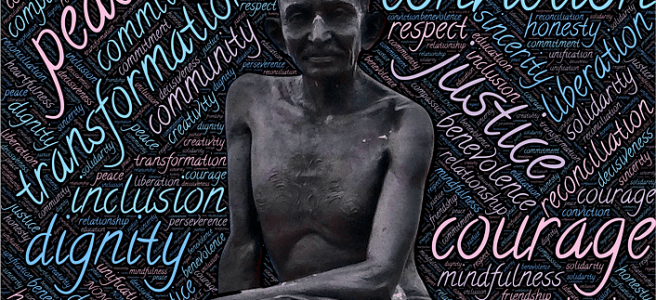
CO2 Scrubbers, Non-Violence, and the Transformation of Pain

nonviolence

I attend a Mennonite Church.

This might seem an unusual choice for me, because I certainly orbit on the outer fringes of mainstream Christianity.  I first stumbled across Mennonites when I lived in Upstate New York.  I drove past a little Mennonite USA fellowship for two years before I got the courage to try it out.  All I knew at the time was that Mennonites are cousins of the Amish, and that they are staunch pacifists.  I wasn’t sure what to expect the first time I entered the church;  would I be out of place not wearing a head covering or plain clothes?  Would I be way too progressive for them?

As it turned out, I fit into that church quite nicely, and they helped continue me on my journey of exploration into pacifism, non-violence, and how we as humans should approach pain and suffering in life.

Fast forward a few years – I am now back in Indianapolis.  Once again I found myself hovering around the edges of Christianity, unsure if I wanted to be in or out. And once again, I stumbled across a Mennonite church, and again, it is the right fit for me.  It’s a community that asks the hard questions and wants to listen to all the answers given in response, even the ones that might sit uncomfortably or require change.

As of late, we have been discussing what it means to be Mennonite andof Anabaptist heritage in today’s world.  At one time, Anabaptists were a group that were being persecuted for their faith and ideals, and they felt the need to retreat and seclude themselves in safety away from mainstream culture.  But, from what I’ve learned, since WWII, many Mennonites have realized that they have a great deal to offer the world, especially in living out the non-violence teachings of Jesus.

In our Sunday classes, we have had vigorous conversations on the requirements for real, long-lasting peace, as well as the myth of redemptive violence.  At one point, someone suggested that instead of fighting back against violence only in overt, active, aggressive ways, we as followers of Jesus need to absorb violence from the worldto keep it from being perpetuated.

So, my mind making the weird connections it does, I immediately thought of : Apollo 13 – you know, that amazing movie with Tom Hanks,  Bill Paxton (RIP), and Lieutenant Dan.  There is one period in the movie where a crisis evolved over the high levels of carbon dioxide building up in the module the astronauts were in, the result of them exhaling gaseous wastes from their bodies without a working air filtration system.   The scientists on the ground in Houston saw that the required oxygen levels were fine, but CO2 was gradually increasing and would reach toxic levels if not dealt with quickly.  NASA engineers frantically went to work, using materials available to the flight crew, to create scrubbers that would draw the excess CO2 out of the air and safely contain it.

I picture in my mind non-violent followers of Jesus or Buddha or name-your-guru who act as violence scrubbers in the world.  People who can handle bad, hard things and pull away the violent spirit of those things from humanity.  But what does that look like?  And how to people who scrub the world free of violence not be hardened and broken from the horrors and injustice that occur everyday?

Richard Rohr, that great Franciscan contemplative who I love to quote, frequently remarks that if we don’t transform our pain, we will transmit it. And the problem is, most people have no clue how to transform their pain.  We do everything possible to distract ourselves from it, cover it up, blame it on everything outside of ourselves – but we continue to suffer and remain imprisoned and burdened by suffering.

“Mature religion is about transforming history and individuals so that we don’t keep handing the pain on to the next generation.” 

This is what Rohr says true spirituality is about: learning what to do with our pain and suffering.  And when we learn how to deal with our own personal suffering, we carve out space to be able to hold the suffering of others.  Not in a neurotic, codependent way, but in such a way that transforms it, changes it fundamentally.  My mind is now going to the idea of catalytic converters….I will refrain from jumping onto that metaphor here.

One of my favorite Buddhist teachers, Pema Chodron, teaches a practicethat reminds me of violence scrubbing and pain transformation.  It is called Tonglen meditation, and if I understand correctly, is part of the Tibetan Buddhist traditions.   According to Pema, we each have a soft spot inside of us, where we are vulnerable and have the capacity for compassion towards ourselves and others.  We often close this space up because of fear and involuntarily harden ourselves against our pain and the pain of others.  Tonglen is a breathing practice that is about learning to be willing to take in the pain and suffering of others, and then sending back happiness to everyone.  She writes that if we can learn to tolerate and sit with pain and hard things within ourselves, we learn not to fear them, and “we increase our capacity for fear and equanimity.”

“We breathe in what is painful and unwanted with the sincere wish that we and others could be free of suffering. As we do so, we drop the story line that goes along with the pain and feel the underlying energy. We completely open our hearts and minds to whatever arises. Exhaling, we sent out relief from the pain with the intention that we and others be happy.”  ((The Places That Scare You: A Guide to Fearlessness in Difficult Times).

Every so often a great person rises that embodies violence scrubbing.  Mother Teresa, Ghandi, Martin Luther King, Jr., the Dalai Lama, Desmund Tutu…just to name a few of the more well-known ones.  Somehow, they have taken on the corporate pain of thousands of people without having it break them, and we have all benefited as a result.

It seems like the last year has seen ever-rising levels of toxicity in our world, with countless varieties of violence threatening the achievement of a lasting peace. At the same time, so many people are turning their backs on religion, with good reason, especially when religious institutions align themselves with the propagation and endorsement of violence.   But we can’t rely on a few greats like those I mentioned above to save us. We must find in ourselves the courage to face our pain so that we don’t keep passing it on to our children.  Like the astronauts of Apollo 13, we don’t have the choice to sit back and hope we’ll arrive at our destination before we breach a toxicity threshold.  We need to grasp on to mature spirituality, use the tools we have at our disposal, and “be the change we want to see in the world.” (Ghandi)