
Shame and the Intuitive Art of Footwashing

Photo credit: Photo by EVG Kowalievska

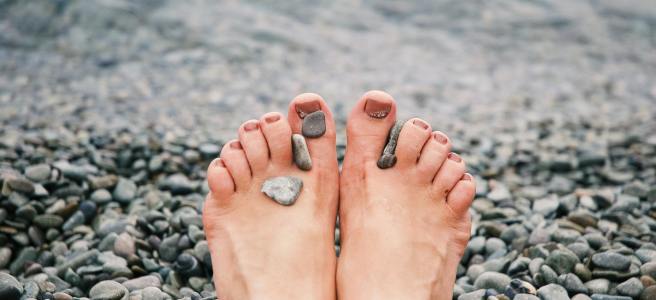
Last weekend I went and got a manicure and pedicure…the deluxe version that takes 2 hours. This has become a regular self care activity for me thanks to a couple of my coworkers who totally got me hooked on it last year. Following the completion of a 50k trail race back in March, my feet were in TERRIBLE shape and missing a couple of toenails. I wasn’t sure there was going to be much coming back from that foot trauma for a while, but as usual, the nail tech at my favorite shop worked his magic and made my feet look good enough again to embrace sandal-wearing and barefoot walking in public this summer.

While I was sitting in the massage chair, being vehemently kneaded in the back and having warm, lavender-scented foot scrub rubbed into my feet and legs, I started thinking about the stories of Jesus and foot washing in the Gospels…you know, as one automatically does when getting a pedicure. In John 13, Jesus wrapped a towel around himself, a sign of meekness and submission that would be totally unexpected from a respected rabbi, much less the Son of Man, and began to wash the feet of his disciples. Simon, the feisty disciple out of Jesus’ 12 followers, initially adamantly refused to allow Jesus to wash his feet. To which Jesus tenderly rebuked him and explained to him that his (Jesus’) message was that we are to serve each other, even in the lowliest of things, like washing the mud and grime and who knows what else from dirty feet. None of us is worthier or more important than anyone else, no matter our privilege or status.

When I was growing up listening to sermons on this story, and then as a Bible major in college, emphasis was placed on the importance of humbling oneself, letting go of ego and sense of status, and being willing to serve the least among us…those in society who may be considered unworthy, or untouchables, or generally “other” and beneath us. This interpretation is certainly a good one, and obvious from reading the gospel text; we all need to learn the lesson that we are interconnected and equally deserving, and it is good for us to learn to set aside our personal preferences and sometimes embrace any “ick” we perceive in various situations so that we can offer love and service to others. But as I was getting my feet tuned up during my pedicure, I flipped the storyline in my head and for the first time viewed foot washing from the perspective of the person having their feet washed. Foot washing, both literally and metaphorically, is a humbling and helpful practice for the washer, especially if they come from a stance of privilege and status and wellbeing. But just as, or maybe even more important, is the ability of the person having their feet washed…to allow it. Which made me think that maybe the whole point of foot washing (or general service and outreach to others, moving beyond this metaphor) is not to just reach out for the feet all those who are brave enough to strut up and stick a foot out… Maybe foot washing is about humbling ourselves to not only serve others, but also to do the harder work of gently and carefully coaxing out the ones who desperately need their feet washed but are too ashamed and afraid to reach for that help.

********************************************************************************************************
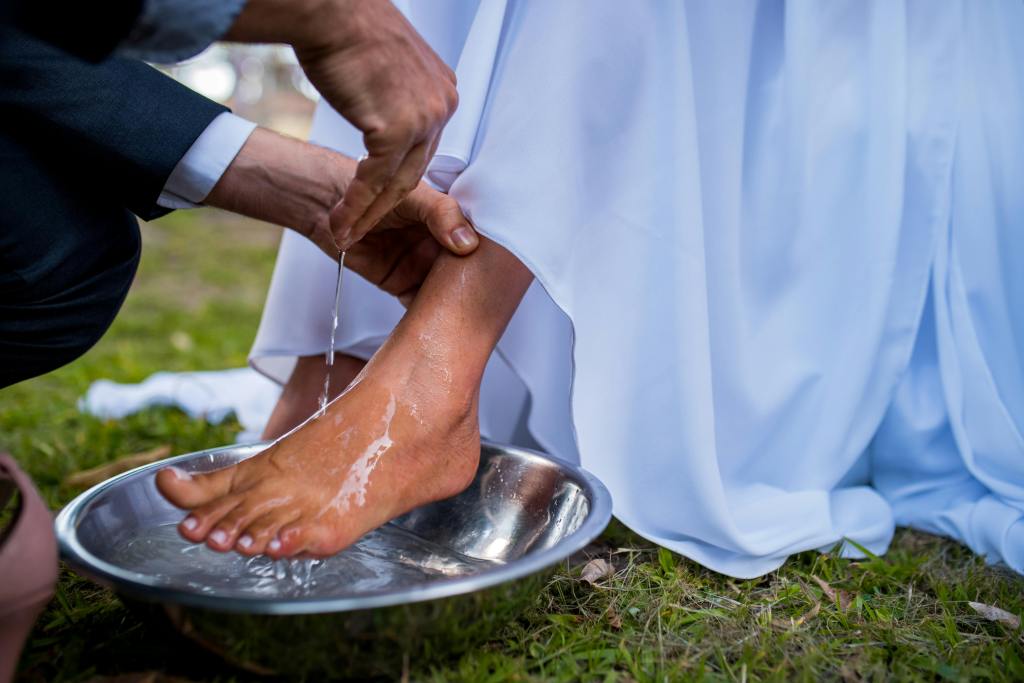
Photo credit: Samuel Lima

For a huge chunk of my life, I had major shame issues around my feet. It’s not really relevant to go into details about why, but let’s just say it significantly affected me for a long time. Decades. As an adult, I largely got over the shame issues because they were related to a bunch of other topics I addressed in years of therapy and shadow work. However, about the same time I started getting over those shame issues, I became interested into long distance running. My toes and toenails have never been quite the same since. It took me running several marathon-length distances, especially on trails, to realize how much my feet swell at certain distances, and that my running shoes need to be at least a 1/2 size to a full size larger than the shoe size I typically wear on a daily basis. Even with bigger shoes, long distance trail running, with repeated downhill stretches, cause one’s toes to slam repeatedly into the front of the shoebox. Inevitably, blood blisters develop underneath your toenails and eventually some of those toenails will just give up the ghost and fall off. Big toenails will half break off and then never grow back quite normally; instead, they grow out thicker and with ridges.

This loss of toenails from running used to really bother me; I mean, if you’re wearing sandals during the summer and you’re missing toenails, people might not instinctively ascertain that you’re a runner and you legit earned those toenail losses by pounding mile after mile of pavement and single track. But I’m getting over this, and learning to just suck it up and ask for help in making my feet presentable. I was reluctant to go in to the nail salon the other day because of two of my missing toenails, but I did anyway, and wouldn’t you know…my summer feet were salvaged.

Now, I know that no one reading this really cares about my toenails, their color, or what shape they are in. And that’s really not the point of this post. The overall premise that I want to explore is how shame keeps people from asking for help from the people who can give it to them. And, on the flipside, the foot washers…the people who are capable of offering help….must learn to see the offering of help as an artistic practice that must be guided by empathy and love, intuition, and really good boundaries.

**********************************************************************************************************************

Shame is the greatest cause of debility and loss of a sense of self-agency in life, in my opinion. The worst part about it is that it is often hidden behind masks of the people who carry it. Behaviors that result from shame in one’s life are so frequently misread and misunderstood by others, often leading to the shame-filled person being labeled as angry, or frigid, or snobbish, or aloof, or bitchy, or weak. It’s all the worse when the person driven by shame doesn’t KNOW they are driven by shame. To top it off, we have unspoken rules within cultures that prescribe who is allowed to admit and express that they are filled with shame, and who are told to just suck up their emotions and insecurities and get on with life. Thanks for the good reminder, Brené.

Undealt-with shame can lead to depression and other mental health disorders, anger/rage, and physical un-wellness…both as a result of self neglect and because the body has stored up trauma and unprocessed emotions for so long that it is forced to eventually express itself in the form of illness or the general manifestation of negative external events. Think The Body Keeps The Score and When The Body Says No. Even with my short time working in healthcare as a nurse and now nurse practitioner, the link between childhood trauma, complex PTSD, and the presence of autoimmune disease is so strikingly clear and obvious to me on a daily basis. But even more than autoimmune process triggering by environmental and interpersonal influences from one’s past and current circumstances, I see people who are struggling with poor health (emotional, spiritual, and physical) because they didn’t know that help was available, didn’t know what questions to ask get the help they needed, or they felt so unworthy and ashamed to ask for help, that their health issues piled up over time, eventually resulting in major un-wellness and disease in their bodies.

************************************************************************************************************************

Photo credit: Antoni Shkraba Studio:

************************************************************************************************************************

The first time I saw a truly diseased foot was when I was a brand new nurse working on an ortho/trauma unit. I was in my late 30s by then, but really had little idea at the time how devastating diabetes could be to people’s extremities, especially their feet and toes. One of my patients on that unit, in my first few months of nursing, had a foot with completely necrotic toes. They were black and leathery and I remember being horrified when I was told that the physician caring for the patient expected the toes to “auto-amputate”…basically fall off on their own. In the meantime, I was to apply betadine to the toes on a daily basis to help prevent infection…my own literal task of foot washing, if you will. I had that patient for several days and prayed each day that his toes would not “auto-amputate” during my shift. I also recall wondering how and why a person could let their feet get to that terrible of shape before seeking help.

Since those first few months as a nurse, I’ve seen a ton of foot and lower extremity disease. Now, working in Infectious Disease as a nurse practitioner, I see patients with foot infections everyday, mostly resulting from uncontrolled diabetes or poor vascular flow to their lower extremities. I recall one patient who initially came to the hospital with cardiac concerns; but due to an odd smell coming from the patient, the attending physician pulled off the patient’s socks to discover a foot that was over half necrotic….tar black in color….that ultimately required a below the knee amputation. The situation was really sad, because if healthcare providers had been aware of the problem and able to intervene much sooner, the patient probably could have had at least some blood flow restored to the foot and avoided such a significant amputation.

So many people intersect with the healthcare system far too late to prevent or reverse many of their health problems. And while the reasons for this are usually complicated and numerous, I have seen countless situations where intense shame and embarrassment and a lack of self agency prevented people from reaching out for help until they were desperate and had no other choice.

************************************************************************************************************************

So how exactly is the act of metaphorical foot washing, or serving others who are shame-filled and desperately in need of help, an art?

I think the primary answer is that humans cannot be approached through a reductionistic, mechanistic model and be expected to achieve sustainable wellness.. Based on what I can tell and have experienced in my life, humans are complex, nuanced, layered beings who are not just a bunch of parts and systems that function together, although unfortunately, much of Western medicine approaches the subject this way. Pardon my woefully lacking knowledge of quantum physics, but I like to think of humans in terms of quantum entanglement…both in how all of the aspects of their bodies work together as well as how humans interact with each other in relationship. Simply put, quantum entanglement is the idea that particles become interconnected, such that the state of one particle affects the state of another, regardless of the distance between them. This concept has been extrapolated by some scientists and spiritual seekers, including well thought of theoretical physicists, as applying to things like intuition, the collective unconscious, empathy, synchronicities, and the possibility that we are all part of a larger, more organized, whole. I’m currently reading Wholeness and the Implicate Order by the late physicist David Bohm, and having my mind blown.

Formulas don’t apply to human healing…physically or emotionally. Now, for sure, at some level, there are general principles of medical therapy that tend to produce similar results. We have evidence of this through well designed and executed scientific studies and research. As for psychological and spiritual healing, we have general archetypal patterns we can reference, as well as various therapy modalities that we can offer to people that appear to “work” and help them overcome personal struggles, traumatic events, move forward in personal growth, etc. Some psychotropic drugs appear to offer relief from anxiety, mood disorders, and depressive states, at least for a while. We have medical protools and treatment guidelines that often move patients in the general direction we want them to go as evidenced by labs, imaging, and their overall clinical pictures. But ultimately, healing…in all the ways it is needed, is not achieved through a one-size fits all approach. Even “alternative’ avenues like psychedelics, breathwork, Reiki, and other “non-medical” mind-body modalities offer dramatic change in some people while seeming to barely affect others.

The art of foot washing is not to just indiscriminately give out what we currently have to offer (or what we THINK we have to offer) to those in front of us who need help. This art, rather, involves some deep introspection on the part of the washer, to be able to read situations and intentions, perceive what may be needed or not needed in various settings, understand as best they can their own motivations, and be able to synthesize both analytical and intuitive knowledge in how they interact with the person whose “feet are being washed”. The idea of “intuitive art”, as described in this post’s title involves approaching service via a creative process that includes spontaneity, creativity, the ability to trust one’s “gut”, focusing on the journey and not just the final result, being open to experimentation (ethically, of course), and all of this done in a non-judgemental space….basically the exact opposite approach than that of interacting with others through a reductionist, mechanistic, black and white model. Whew…sorry for that really long sentence!

The following are a few considerations that came to mind that I think we must ask in order to creatively respond to and approach service to others, especially when shame is involved:

  • What do we, as the “foot washer” have to offer the person (or people) in front of us? What are we skilled at? What are we trained in? What are we absolutely not qualified to talk about or give advice about? How much time do we legitimately have to offer this person? Are we tapped into our intuition and do we trust ourselves and our instincts? Are we able to determine what role is ours to play in any specific situation?
  • Are we aware of the things that influence us personally and how we interact with others? Are we aware of our implicit biases? Are we aware of our own shadows? Do we have a history of specific traumas that might impact how we approach and interact with this person? Do we have any codependency issues? Are we aware of any lingering shame that WE carry and haven’t healed? Are we able to listen without judgements? Are we able to offer help without inappropriately becoming emotionally involved and overly invested in the situation? Do we approach life through a “right versus wrong” model or rules-based mindset? Have we every considered our attachment styles and how that might influence all of our relationships? Do we have healthy interpersonal boundaries and stick to them? Do we have a good sense of where we end and another person starts? Do we feel like it is our job to “fix” people?
  • Most important of all: has this person invited us or given permission for us to offer any level of help? Is the person we are aiming to help READY to receive help? Are they ready to receive help from US? Are we opinion-spewing all over them or have they asked us for our thoughts and insights? For those of us who engage in energy work and medical intuitive practices, have they given us clear permission to look within them and their energy patterns? Is the timing for helping right? Is the setting right? Are we inadvertently or unintentionally pressuring or manipulating the person to take help from us when they aren’t wanting it or aren’t ready for it? On the flip side, is the person asking for too much of us…beyond what we are capable of giving, wanting to give, or can appropriately give?

************************************************************************************************************************

So, clearly, that long list of questions implies that foot washing and service, as an art, is not necessarily easy. To do it well, we have to be good listeners and observers, to not be afraid to look deeply at our own “stuff”, and to be able to perceive what belongs to us and what belongs to others. Below are a couple of areas I want to extrapolate on related to the questions above – not all tied directly to each other, but definitely related, and not in any particular order. I’m not necessarily coming to any conclusions these extrapolations, but mostly thinking about how they might tie into the idea behind this whole post.

  1. Service to others, especially in working with others who are experiencing shame (or are in a position often considered “less than” by our society, such as minority status, poverty, etc), requires that we let go of our egos and what may make us as foot washers feel good. Little side story: I grew up in the church, got a Bible degree, have been on some mission trips to various places, and have generally experienced alot of American-flavored Christianity as a whole. Something that has been very popular for decades is for folks from the US to go on short-term mission trips around the world, whether it be medical, to hold revivals, to support local long term missionaries, etc. At my current age, looking back over my years active involved in churches and these kinds of activities, I have alot of thoughts about the usefulness of mission trips. There are some absolute benefits for sure….they often open the eyes of people about the way others around the world live, and the struggles they may have that differ from those in our country. I can say personally that short term mission trips changed me as a person for the better and had a direct influence on how I wanted to live my life. And, short term medical mission trips, for example, can offer some quality, concentrated medical care to needed areas and people groups that they might not have otherwise gotten. BUT…there is a danger in providing these kinds of “services”, especially when we don’t evaluate our motivations, understand the culture we are serving, or when we drop in for a week or two to a complicated situation and then easily fly back home without having to wrestle with long term implications of how our little trips might have affected the people we left behind. I kind of suspect that short term mission trips, church-based or not, have frequently done as much damage as they have good, largely because it is very easy for us to, even unconsciously, feel like saviors going to help those poor people less fortunate than us. These kinds of trips don’t always stop and look carefully at what is actually needed in a certain area by specific people at a given time, but enthusiastically bombard them with what WE THINK they need and want.
  2. Trying to serve people who struggle with shame can be so complicated for so many reasons. As mentioned earlier, some people can hide their shame so well, because they are high functioning and so nobody on the periphery may ever know they need help. Mental health issues can also dramatically influence the “foot washing process”, especially if the shame filled person has a personality disorder like border-line, or is just really needy because of anxious or other fear-based attachments. As I look back on my 20s and early 30s, I can see that I, in some ways, was a pretty needy person. Which makes me cringe because I personally know how hard it can be to have needy people in your life. I think when people who are dealing with shame, like I did for so long, see others outside of them who might be able to help either carry the burden of the shame or actually help heal it (foot washers), we (those who need our feet washed) can really latch on tight and ask for too much of the foot washers.
    • This is where really good boundaries are important. People who are healing from shame often take a while to learn that healing is an inside job: they can receive help and insight and advice from those around them, but they actually have to do the hard work of healing themselves. Shame makes us desperately want a savior, a white knight to come and fix things for us and take care of us. But that’s not the way life works. Nobody is coming to save us. We must be our own saviors. Someone who understands the intuitive art of foot washing knows this, and will keep boundaries in place…making sure that each party knows what is an isn’t theirs. Side note: when we actually learn we can save ourselves….self-agency and trust in ourselves just grows exponentially.
    • I’ve frequently looked back over my own life and the healing journey from shame that I’ve been on. I recognized that the people that inspired me the most to grow and become the person I am now where not the people who were emotionally entangled with me and had terrible boundaries. Nor were they the people who were there any time I thought I needed them. Nor were they the people who tried to “fix” me. Nope…the people that prompted the biggest growth in my life were those that had solid boundaries: they knew who they were and what they had to offer; they also had alot of faith in me and what I could be come, but they were not so invested that their sense of wellbeing and satisfaction was at all a function of how I was doing emotionally or physically. The people that helped changed my life gave me help when I needed it, but then expected me to continue to do my own work and to go search out other resources. And most of all, I was inspired to change by them by how I saw them live their lives…secure in themselves, curious and open-minded about everything, with a strong trust in their own intuition and gut instincts and self-worth.
  3. I think we all need to work on our perceptions of others, and remember that what we see on the outside of a person is not necessarily indicative of all that is going on on in the inside. This is where intuition is so key: tapping into unseen knowledge that is all around us in the universe that might not be explicitly measured, but it real nonetheless. I think about this alot when caring for patients. For some complicated patients, it would be easy to just write them off as lazy or non-compliant with medical recommendations and prescribed medications, or as people who just make really dumb decisions in life that caused them to end up where they currently are. I think this reductionistic way of thinking, even though I can also be prone to it myself at times, is a really unhelpful way to view humanity. I refuse to believe that people intentionally try to make bad decisions and make their lives more difficult. I am convinced that people generally do the best they know how at the time with the information they have with their perspectives on that information, and that un-dealt with shame can be a noose around people’s necks until others help them recognize and transform it.
    • Intuitive foot washing, per my musing during my pedicure, is the idea of seeing the ‘thing behind the thing”, which requires tuning in to who you are serving, using more than just the five senses…and learning to recognize that your perception of a person’s reality may not at all be what they are experiencing. The “thing behind the thing” is the real deep-seated emotions and beliefs that drive behaviors and how one interacts with the world. In my experience, when one has deep shame about something, it can influence a variety of external behaviors and reactions to the environment around them, and we need to hold alot of grace for them for all of that.
      • When people claim to be angry about something, or afraid of something, or annoyed by something…there is almost always a “thing behind the thing” that is really bothering them. It is almost always related to a core wound or big area of shame that hasn’t healed, and even they might not be aware of that core wound “thing behind the thing” that is driving their emotions or actions or beliefs.
    • And, going back to quantum physics from earlier: we as the observer of the person in front of us are not objective. We individually can’t ever claim to have a grasp on “true” reality or have an absolute understanding of what is going on with a person or their environment. This is because there is a ton of information about that person that we aren’t privy to, but also because reality is subjective and is based on the relationship between us (the observer) and the person we are observing.

************************************************************************************************************************

I’ve kind of gone all over the place with this post, so will start wrapping it up now, but may come back with more thoughts on this topic in the future. I’ve really only scratched the surface of all I want to talk about here. In my nerd-ery, I like to think of these kinds of posts that I sometimes write as another form of quantum entanglement: I go to do something mundane and everyday, like getting. a pedicure, and then suddenly my thought process jets off into what might initially seem to be completely un-related, and I am ultimately reminded that all things are interconnected, no matter how distant they might appear at the macroscopic level.

I am incredibly grateful to all of the people in my own life who have helped me identify my past shame and heal from it, all while maintaining their own strong boundaries and showing me what it means to trust oneself, develop securely attached relationships, and learn to ask for help in healthy, appropriate ways when it is most needed.

And I am super grateful nail techs who can make my feet pretty again after I’ve beaten them bloody doing the things I love to do.

To grow exponentially, shame absolutely needs three things: secrecy, silence, and judgment. Shame cannot survive two things: being spoken and being met with empathy.” -Brené Brown

42 Is The Answer To Everything

Photo credit: Isaac Bowen

Have you ever had periods of time in your life where you seem to be hit by a certain theme, repeatedly, and from all directions? And so you decide that maybe the universe is trying to tell you something?

The first time I really remember this kind of thing happening to me (although I’m sure my memory is failing me), was back in college. I was a double major at a fairly conservative Christian university whose foundation was in the Churches of Christ. One of my majors was Missions, so on top of the requisite Bible classes that every student had to take, I took alot of theology and ministry classes. As a side note, after I graduated and people asked me what I majored in during college, I would respond: “Biochemistry and Missions”. For those who didn’t have a church background or did but weren’t paying much attention at the time, I would often get confused looks and questions as to what a “Missions” major was. I used to be so amused because they would frequently think it was some kind of education track for people wanting to go into intelligence or security. I guess one could make the argument that it was …..stealth intelligence missions for how to bring people to Jesus in ways that didn’t come across as flat-out proselytizing or manipulation. Anyway….moving back to my first point…..

When I was in college, the theme that hit me relentlessly from every angle was, of all things….baptism. Looking back now, I guess it makes some sense because the issue of baptism is one big point of contention that separates the Churches of Christ from so many other denominations. But at the time, while all the Church of Christers seemed to be talking about nothing but baptism, all the Baptists in my life (the denomination I grew up in) also seemed to be talking about baptism.

Whether or not the Lord actually was all that worried about me learning the soundest theology surrounding the practice of baptism, and which version would actually get me saved….I have no clue. Ok, I completely doubt that any deity was behind me being pestered with baptism rhetoric. Either way, I was paying attention to all the coincidences and I took it upon myself to do a deep dive into baptism theology and determine what I actually believed about it.

But…..you didn’t start reading this post to find out what I think about Christian baptism, and it is absolutely NOT the point of me writing today….nor is baptismal theology anything that keeps me up at night anymore. Thank God for that….looking back, the how’s and why’s of baptism are such a small, silly matter to base our entire understandings of eternal destinations on.

************************************************************************************************************************

Does the universe actually coordinate efforts to inundate us with a particular message that we need to hear? I don’t know. Answering that with certitude isn’t so important to me anymore. However, it does seem to me that the same lessons will keep coming back around to us repeatedly until we learn them. One could make the argument that we are attracting these situations to ourselves, and once we get the lesson or receive some healing in that particular area, we stop attracting them. But I don’t know….sometimes it feels completely uncanny about how I run across the same themes or topics from seemingly unrelated sources.

One theme that has been coming at me again and again over the last year and a half?

The Hitchhiker’s Guide to the Galaxy. And more specifically…that 42 is the answer to everything.

I never read the series, didn’t know anything about it, and had only just heard of the title before last year. The first time I ever learned anything of substance about it was when I was in a relationship with Shithead the Narcissist. He brought it up in a conversation, most of the content of which I don’t recall, and for the first time I learned about this magical number, 42. I made a mental note to get a copy of the book, but it slipped my mind until just a few months ago.

One afternoon, I randomly thought of the book, and the fact that I am currently 42. So I ordered it on Audible and stretched out on my deck couch to listen to a few chapters. After that afternoon I got distracted away by other audiobooks and didn’t get HHGTTG finished. But, within a month of buying the book, I met two new people, who were completely unrelated to each other…and both brought up HHGTTG during my early conversations with each of them.

Well, I thought to myself….that is either the most bizarre coincidence ever, or the Universe somehow thinks that reading this book will be a game changer for me, or I somehow attract a particular breed of literature fanatics, or the number 42 is on a mission to teach me something, or I’m suddenly paying attention to patterns where I hadn’t before, or……meh, who knows?

Whatever the reason that this book keeps popping up in various areas of my life, I am paying attention, and it has actually really been the inspiration for some deep thinking on my part.

************************************************************************************************************************

I’ve been on this earth, as far as I can tell and as far as my birth certificate indicates, for 42 whole years. It feels like I’ve lived a few different lives within that timeframe, and yet in the grand scheme of things, 42 is just a mere blip in the lifetime of this planet and humanity in general. I’m not at all the same person I was even a decade ago, and yet in other ways, I am more of that person, in a “realer” way, than ever.

Back in my college days, while a Missions major taking a bunch of Bible and theology classes, I first learned about how people groups throughout history, including the Hebrews, dervied alot of significance, meaning, and understanding about how the world operates, from numbers and numerology. I recall learning about some important Jewish numeric concepts that were woven into Jesus’ stories in the Gospels, and being delighted over the discovery that all the details included in the texts were there for a reason….they MEANT something. This is especially true in the book of Matthew, the Gospel text that has the most “Jewish flavor.” Certain numbers show up over and over in the Old Testament and Gospels, and carry mystical qualities with them. 3, 7, 12, and 40 are just a few examples that are huge themes in the texts. Equally fascinating to me, although admittedly I don’t know much about it, is how the letters of the Hebrew alphabet are each assigned numerical values in a system called gematria. This system is very important in Kabbalah, the mystical tradition of Judaism, and is used as a method for interpreting the sacred texts.

But apart from Jewish mysticism, even good old Evangelicals sometimes take a stab at understanding the workings of God by appropriating these ancient tools. Biblestudy.org notes multiple occasions where the number “42” shows up in the Bible. They point out that the number 42 is strongly linked to Anti-Christ themes, but also incidentally note that the phrase “little children” appears 42 times in the Old Testament. Maybe the writer considers kids to be spawns of Satan, I don’t know.

A quick Wikipedia search lists a plethora of other interesting facts about the number 42, from the realms of science and technology, to literature, music, sports, mathematics, and astronomy. Here are a few of my favorite facts from the list:

  1. With Windows 10, the default timeframe in which you had to change passwords was 42 days. Super random.
  2. 42 is the atomic number for molybdenum, which is an element required in trace amounts by a set of enzymes in our bodies that are crucial for metabolizing and breaking down certain toxic materials.
  3. 42 is the sum of the numbers on a pair of dice.

I know what you’re thinking. “Julie, just because a number shows up alot doesn’t mean it is extra special or of more importance than the other numbers. Data bias can totally make it seem like 42 shows up in life in a much greater proportion than other numbers.” To which I would say, right on. Although, 42 still has a much longer Wikipedia profile than, say, 63. (I also looked up the number 522, which sadly does not boast its own Wikipedia page. BUT, according to numerologynation.com, if you see 522 alot in life, it’s a good sign that your angels are trying to pass on encouraging messages to you to stay the course and believe in yourself. Do with that information what you will.)

************************************************************************************************************************

My 42nd year, and now this year where I am officially considered 42 years old, have been among the most formative and life-changing for me. Several of my biggest demons have been mostly laid to rest. Some of the puzzle pieces I’ve been searching for, forever it seems, have finally appeared. I’ve grown tremendously in my ability to hold my ground, set up boundaries, walk away from toxic people, and hang tight to those I love dearly even when the holding tight is painful and uncertain.

Most importantly, this has been the year that I’ve finally grasped that I am fundamentally OK, that I belong in this world and don’t have to ‘deserve” my existence, and that all I need is within myself. At first, I only believed these things for a few short seconds at a time, held within the passing knowing of brief mystical encounters or in the moments when I could accept into my heart what my therapist said was true of me, and not just my head. But as this year has passed, I can believe and hold onto those beliefs for a little longer each time, and as a result, the way I move through the world and respond to the world is changing….slowly but surely.

One thing that I’ve learned this year doing trauma therapy is that I’m a magical thinker. I’ve always known that I believed in the possibility of miracles and crazy shit to happen in the universe, but I never realized until a few months ago that magical thinking is based way more in trying to survive and and as a coping mechanism than it is solely being way more in touch with the inner workings of the universe than the general masses.

Along the same lines, I used to think that me being an empathetic and sensitive person was a fundamental inherent quality that helped me truly see others and their pain more deeply and clearly; this also made life a lot more painful for me because I felt the need to help people carry all of their pain. Turns out, while I may have empathetic tendencies, and I do love people greatly, alot of this sensitivity was also a trauma response developed in childhood. I had to learn to be hypervigilant when interacting with people in order to anticipate what might be coming, and to protect myself. Old habits that cut deep neural grooves die hard.

These, my revelations about magical thinking and hard core empathy, are just two examples of “answers” that came my way in my 42nd year. I’ve had many more. And if I’m honest, there’s this magical thinking side of me that hopes that 42 is the BIG year, where I completely “wake up”, shed the last of my baggage, and live out the rest of my life relatively free of any self-induced suffering.

But, that kind of thinking, I also recognize, completely misses the entire point. Another, perhaps the most important lesson that I’ve been learning, is that the REAL magic sauce is the “right here, right now.” A specific destination, or reaching year 42 and hoping for some spectacular life alterations, or seeking a final state of enlightenment….those things are always about clinging to some future ideas. The future is nothing but an illusion, a dream. Just as the past is nothing but memories and dreams. Neither exist outside of our minds. All that we truly have is this moment we are in right now.

The clip from HHGTTG is funny and so very true because it points out the absurdity in much of the way we as humans live. The characters asked for an answer concerning the point of life, the universe, and everything….and were told to come back in 7.5 million years for an answer. When they did come back, they were celebrating hard in anticipation of an answer that was going to suddenly cause everything to make sense and give them ultimate peace. But the exact opposite was true….the answer they received was unfulfilling and left them more confused than when they originally asked their question. Then they were told that to understand the answer they were given, they must ask the correct question, which would require yet another long enigmatic search.

The big takeaway from year 42 for me is this: ask the big questions, sit in them, and if it feels helpful or you are driven by curiosity, search for the answers. But don’t do that searching at the expense of living fully RIGHT NOW. How many of us spend the bulk of our lives reliving in our minds everything that happened in our pasts, or constantly imagining what could happen in the future…good or bad…so much so that we forget to actually live our lives? Or we become cemented in place, paralyzed with fear of all the “what-ifs?” Instead of joying in sitting next to a person we love and reveling in that time with them, we panic and fret that we will lose them and so spend that precious time trying to convince them not to leave? Or, we can’t fully be with the people and places we are with because we allow our minds to be tortured by words and actions of people from long ago that are not with us now? Or we fritter away our time developing contingency plans for all the terrible things that probably won’t happen? Or we escape to fantasy worlds instead of testing reality and questioning our thoughts/beliefs and discovering that we actually do live in a pretty benevolent universe.

The answer to life, the universe, and everything is 42….and the answer to 42 is…..just Be Here Now. Live Now. Experience all the things now. Embrace and stop fighting against reality. Love hard the people who are right in front of you, just the way they are, just as you are. Don’t miss out on living life because you are afraid of the things that have come before or might possibly come in the future.

It occurred to me just now that maybe the theme of baptism does in fact fit in this post. In the Gospel of John, Nicodemus sought out Jesus and answers to the big life questions. Jesus told him that he must be born of both water and the Spirit. It seems fairly clear that being born of water means being born as a physical person into the human predicament. But being born of the Spirit…this gets people hung up.

“Spirit” in Greek is Pneuma (πνεῦμα). This literally translates to breath. I like this so much because breathing is synonymous with life. The first thing all healthcare providers think about in an emergency is making sure that the patient’s airway is protected, because that balance of oxygen/carbon dioxide inflow, outflow, and distribution are critical to maintaining life. So many of the world’s meditation styles and practices focus on the breath. Practices like Stanislov Grof’s Holotropic Breathwork recognize the connection between breathing patterns and deep emotional and psychic healing.

Breathing is life. And being born of the Spirit, then, is being born of life. In other words, being born into Is-ness, Reality, the Truth of this Moment.

Being born of the Spirit means we allow ourselves to come into an existence where we stop struggling, where we stop trying to escape into what came before or what might come later, and we learn to simply love what is. A billion thanks to teachers like Byron Katie who are helping me to gradually understand these things.

Well, anyway, this is a baptismal theology that I can get on board with.

As a final note, the number 42 is apparently considered unlucky in Japanese, because is sounds like the Japanese word for dying. I also find this interesting, because in my 42nd year of life, I did so much work that felt like dying. To get to real life, you have to let go of the things that aren’t real and don’t bring life. Our egos and our scared inner children can balk at this, can’t they? Letting go of our old ways of doing things and operating in the world can be daunting at best and terrifying at worst.

But to harken back one last time to my native Christian language, the apostle Paul….who was a mystic in his own right despite being a bit patriarchal and misogynistic (but I’ll forgive him this), admonished us to leave behind our childish ways…to go deep….to mature in the way we move in the world.

We are grown ups now. We don’t have to create elaborate systems to help us survive the hard things and difficult people that we once were unable to escape. We possess within ourselves all the strength and love and wisdom we need to live this life well. It might feel like a difficult path to see these things. It might feel like we have to die before we discover what truly living is like. It might take us until we are 42 years old to actually feel like we are starting to “get it”. But that’s ok! Because 42 is the answer to for everything, when you’re 42. And 47 is the answer to everything when you are 47. And if you or I are lucky enough to live to 100, that will be splendid, because 100 will be the answer to everything.

The ultimate answer is to be where you are, NOW.

How To Love When You’re Tired

Photo credit; David O’Leary

On Giving Away All Your Ducks

I’ve always loved my kids immensely, from the moment I knew I was carrying them. Which was always pretty quick, because morning sickness kicked in with each of them within about 3 days, and I knew well before those positive pregnancy tests that I was going to be a mom again. I loved their baby months, and hearing their giggles and laughs as toddlers and preschoolers, and all the growing phases of childhood. But I think now, when they are preteens and teens, is one of the funnest times in being a parent. They are really coming into their own identities and discovering what really makes them tick, and it is so amazing to watch. And….they make me laugh SO hard, all the time. I feel like we are constantly talking about the silliest things and laughing until our bellies hurt and tears are running down our cheeks. My children blow me away: I have no clue how I got so lucky.

On the daily, my kids teach me so much. And they share such good advice with me…because, clearly, I need some of it. Here are some solid words I received from my ten year old a few months ago (I don’t typically let me kids swear freely, but this is truth, he was very emphatic about it, and it is something every girl should know):

“Mom, if a guy treats you like crap and denies you of your basic rights, don’t take that shit!”

My oldest son surprises me on a daily basis with his wisdom, patience, and responsibility. He’s only 14, but he regularly is the one reminding me to calm down, to stop overthinking things, to remember good self care, and to get some things off my plate. Not all that long ago I was stressed about something in life, and as he and I drove around town running errands, he told me about a book that he had been reading that he felt like I could learn something from.

Xander: Mom, do you like audiobooks?

Me: I LOVE audiobooks. (Where is he going with this?)

Xander:  There’s a book I’ve been listening to that I think you should also listen to. It’s called The Subtle Art of Not Giving a Duck.

Me: (familiar with a book with a very similar title). Is your DAD aware that you’re listening to this book? (My eyebrows raised)

Xander: No way. But it’s a good book. It’s about how you only have so many ducks in life, so you need to be careful about who you give them away to.  It makes a lot of sense. 

I love this kid so much. He cracks me up and yet straightens me out all at the same time.

************************************************************************************************************************

On Giving Away All Your Other Kinds of Ducks

Just last week I had a conversation with a friend about this same topic; however, since we are grownups, we used the original version that starts with an F, and is the basis of the actual book The Subtle Art of Not Giving a Fuck. I still haven’t read the book, and am not sure if I will, but I think the title really says it all. If you are a people pleaser, or still paralyzed in various types of shame, or toxic beliefs…learning to not give a flip about certain people or situations is quite the endeavor. Because, as many of you will know, we kind of people want to be “good people”, and we inherited the belief early on in life that to actually be good people, we have to love everyone, be friends with everyone, be emotionally invested in everyone,…all of that stuff. We give way too many fucks about too much stuff. And so learning to not do that anymore is akin to an art form.

This friend that I was chatting with agreed with me when I told him that I’m at the age now where I realize that some things are just not worth wasting energy on. And looking back, there are some situations and people that I just spent WAY to much time and energy on, at my own expense. So many times certain people were very happy to drain me of my energy, resources, whatever I was willing to give them…and offer absolutely nothing in return. My friend told me that he feels like at his age, he is done playing games with people. He says what he wants and doesn’t want, and chooses intentionally where he expends his emotional and physical energy.

I think this makes ALOT of sense, but it’s still hard for me…a recovering codependent, people-pleasing, emerger from childhood shame. But, I am getting better at it and it is really liberating. It’s also nice to not feel exhausted all the time by this insane inner urge to be all things to all people….while trying to save the environment, and be a minimalist, and a super parent, and all those other things I’ve neurotically fallen into but are still good goals to strive for. This is where it really is a subtle art to learn not to give a fuck….because you have to learn yourself really well and figure out what is most important to you. Then you have to evaluate yourself and really understand your strengths and weaknesses. Next, you have to learn to parse all that out in the people and life circumstances that come your way. This is tricky, because most of the time you don’t just encounter a person and know from the very first moment that you are totally ready to invest in them for the long term and are willing to give them some of your precious ducks. (I have met about five people in my life, who I knew from the first instant I talked to them that they were my people, but this is a rare occurrence.) Usually, you have to try people on for a while, watch them in interactions with other people, see how they respond to different environments, etc, to determine if they are people you want to align with. And sometimes, you meet people that you are CERTAIN are going to be your people, and you start investing hard in them, only to be horribly disappointed down the road. Either they weren’t who they originally presented themselves to you as, or they decided you weren’t worth sharing their own ducks with. It’s an art for sure to figure this all out. And maybe a dance, too…the kind where you’re learning the steps only after you’ve gotten on the dance floor with a partner.

************************************************************************************************************************

What is Love, Exactly?

My goal in life is to try to love people as well as I can. I fumble this up quite often, and I know there are so many times when I’m really self-centered and short sighted. But, most of the time, I try my darndest to find commonalities with every person I meet, to truly see them as an individual human being even if for just a split second, and to do to my best to honor and recognize their inherent worth.

Something that is really interesting to me, though, is that so much of my understanding of what love is has been wrong….or maybe not wrong, but misguided…for most of my life. Many of my beliefs about love have largely been unconscious, so thank you God for therapy to help unearth all of this stuff that hasn’t been serving me so well. Some of this will be a tad bit hyperbolic, but in general, I thought that love was about always sacrificing or inconveniencing yourself for other people, never doing or saying things that would make other people uncomfortable, never ever saying blunt, direct truths, never standing firm to have your own needs met, never walking away from people even as they begged you to stay, letting you own boundaries slide in order to make other people happy, etc, etc. I believed that love was a verb, an action, but I definitely had a skewed understanding of it….the verb was always in relation to action towards another person, never an action in the direction of myself and what was actually best for me.

This faulty understanding of love is exhausting. Because it requires you to always be giving, always bowing down, always having to be hyper vigilant about the needs of others, always having to tell yourself to stop feeling resentful and selfish when people wasted YOUR time, YOUR resources, YOUR affection, etc.

I’ve been listening to a great audiobook lately called Not Nice: Surrender the Approval Quest. In one of the chapters, the author made the point that in most cases, being the nicest, most accommodating, pushover who is always deferring to the wants and needs of others is not, in fact, a very loving way to exist in the world. And, it actually comes across to others as repulsive at times. I was driving when I heard this line, and almost stopped dead in my tracks, but had the wherewithal to allow traffic to keep moving. It had never occured to me that the definitions that I had carried of love for much of life are probably some of the least loving ways to be in the world. Having firm boundaries, knowing your worth as an individual, and then interacting with people and situations out of that strong identity might actually be the most loving thing you can do in life. Mind blowing…..that maybe real love is not about giving away all of your ducks all the time to everyone, but in learning the art form of being very picky and deliberate with who you give those ducks to. Well, now.

************************************************************************************************************************

Nurse Ethics and Empathy

I’ve been a nurse now for about two and a half years. It has freaking flown by. I remember five short years ago, trying to face the daunting task of getting divorced and starting nursing school at the same time, and it all seemed like an impossible task. And now, somehow I’ve done all of that and will be graduating with my masters degree in nursing in a few short weeks. Crazy how life just works itself out sometimes.

One thing that is really being pushed in nursing education is how nurses are to be empathetic and supportive, invested caregivers to patients. We are supposed to be advocates, educators, care coordinators, physical caretakers, hand holders, strong listeners, etc….all while being extremely empathetic. Nursing, as many have said before, is both an art and a science. Nurses do some fantastic work, and so very many of them are heroes in their own right and have literally changed people’s lives for the better.

That being said, I will never apologize for saying that some of what we as nurses are taught to be is not healthy and is comes at our own expense. It is strongly implied that we sacrifice ourselves for the betterment of our patients, that we calmly and patiently take abuse and manipulation and understaffing and that one extra responsibility because this is what nurses do. And, all these things that are strongly implied and encouraged for us to do and be comes with a side of ” don’t screw up because you could lose your license.”

A thing I’m convinced about nurses, and I’ve read this elsewhere so it’s not just me making up stuff, is that a huge chunk of nurses are already people-pleasing codependents to begin with. Taking care of people is what we do. It’s how we’re wired. So then, when we are placed into environments where we are told our job is to be superhero empaths that sacrifice our own needs for our patients, every time, we accept it…hook, line, and sinker. Because this is what we believe makes us good people, good healthcare workers. It’s even stronger when the American Nurses Association Code of Ethics gets handed to us in nursing school.

This is not at all a Julie rant against nursing. I LOVE being a nurse, and nurses fill at huge role at the healthcare table that is still being developed and explored in new and innovative ways. But…when nurses give up their own health and self care for others….ALL THE TIME….is that really loving, or even ethical itself?

A topic that has been coming up alot more in recent nursing research are the ideas of compassion fatigue, burnout, vicarious trauma, and stress injuries. Nurses know all about these on a practical level, but the research literature is really just starting to understand how impactful these things are. And while empathy has been touted as a big buzz word lately for teaching people how to interact with others, I have decided that the pursuit to be empathetic all the time is also not the most loving thing to do, and it can be wicked exhausting, too. Because…being empathetic with everyone you encounter, especially as a nurse, requires one to give away entirely too many ducks.

************************************************************************************************************************

Empathy versus Sympathy versus ???

The freaking amazing Brené Brown has written and spoken alot about empathy. She gave a talk on the difference between sympathy and empathy, which was uploaded to youtube in the form of a super clevel animation. Watch this:

This video is really good, and it definitely distinguishes the difference between sympathy and empathy for alot of people that need to hear it. The problem is…when people that are already very far leaning on the empathy side of the spectrum, it just makes us feel even more guilty about not being empathetic and connecting enough with people

Did you notice that Brené referenced a NURSING scholar? Yeah, we know alot about empathy. She listed four components that are part of empathy: learning to take the perspective of the other person, coming to that other person in a non-judgmental way, recognizing emotion in other people, and being able to communicate in the recognition of that emotion. Or, as she then succinctly put it, empathy is FEELING with people. It is about reaching into yourself and finding that feeling within yourself that resonates with what the other person is feeling, and allowing that to be a point of connection.

I love empathy. I love it when people empathize with me. I love it when we connect on a deep level of “I totally understand the shit you’re going through because I have been there before.” But…NO ONE CAN EMPATHIZE WITH EVERY PERSON THEY MEET! Unless, of course, you want to die of utter exhaustion both from actually empathizing with everyone and then also trying to find some kind of connection with people you don’t understand AT ALL and are struggling to find that commonality that will help you to empathize.

There is a reason that nurses frequently crawl out to their cars after every shift and then sleep all day on their days off. It’s partly all the physical work involved, but it’s also because their brains and emotional selves are deplenished from having spent 12 hours straight trying to provide quality, unbiased, empathetic care to patients under the umbrella of a code of ethics that tells them it is their moral duty to do this.

************************************************************************************************************************

Empathy and Sympathy Fatigue

A couple of months ago I took a quick weekend trip up to Chicago to see one of my best friends, who is a mental health therapist and also one of the wisest people I know. (She has also walked beside me through so many hard things in life….she is one of my people, forever) We ate some amazing food, hit up lake Michigan for some early summer kayak therapy, and talked about deep things. Because she and I don’t do small talk. We go straight for the good stuff , every time.

This friend has taught me so much about being authentic and learning how to love people well. So, after our bellies were full and our arms were worn out from rowing, I brought up to her my struggle with empathy, wanting to hear what she thought about it all.

My friend pointed out that empathy and sympathy are opposite ends of a spectrum, and when people only speak of those two ideas, they are leaving out a crucial concept: compassion.

Before she even really started to explain herself, it clicked in my head. My mind went straight back to the Gospels (the Bible was my native language after all, even if I don’t read it much now). There is a story in Matthew 9, where the translated text states that Jesus had COMPASSION on the multitudes. This is what it says:

“Jesus went through all the towns and villages, teaching in their synagogues, proclaiming the good news of the kingdom and healing every disease and sickness. 36 When he saw the crowds, he had compassion on them, because they were harassed and helpless, like sheep without a shepherd. 37 Then he said to his disciples, “The harvest is plentiful but the workers are few. 38 Ask the Lord of the harvest, therefore, to send out workers into his harvest field.”

The connection that my brain made here was that Jesus felt compassion for the people, he understood their plight and struggles and pain, but he did NOT get personally involved with every single broken or hurting person around him. He recognized that it was not his task to save every single person, but that other people were meant to join in the job. (This may be the worst exegesis ever, but work with me here. Also, I know that the text says he healed every sickness, but clearly, he was not erasing every plight that the masses were experiencing).

As my friend and I talked, I recognized that there is a place in the middle….a very loving place….that is not completely detached and platitudinous, like sympathy can be…and yet it is not fully “all in” emotionally invested, like empathy requires. Compassion lies in between…in a space that is real and loving and meaningful, yet doesn’t require you to deprive yourself of self love and self care by demanding all of your ducks all the time. Compassion fills that gap where you wish you had something substantial to give, but you know you don’t. And yet, it’s so much more than just “thoughts and prayers”. Because compassion requires some mental and emotional effort, but it also recognizes that it is not your individual responsibility to single-handedly save the whole goddamn world.

************************************************************************************************************************

Vicarious Trauma

So, I now think that compassion fatigue is a complete misnomer. It should be called empathy fatigue. Because compassion is about caring for people, and loving them at a fundamental level and wanting the very best outcomes for them, but at the same time realizing that you are not in the position to do a deep dive into their lives and pain and help them find a way out. Empathy fatigue is what burns people out. And while I am absolutely not an expert in this area, I think that maybe it is empathy fatigue that most often leads to vicarious trauma. Empathy, at some level, as described in Brené’s video, requires us to get down in the dark places with people This can be OK if we each personally have the resilience and emotional strength to not be overcome by that darkness and pain. But, if we haven’t worked through our own struggles in life or faced our own demons, or have a strong resilience and identity, I think that trying to be empathetic can just about wipe us out if we’re not careful. We can end up being traumatized by seeing or hearing about someone else’s trauma, termed vicarious trauma. There’s something about compassion as an alternative, though, that lets us maybe see what’s going on from a distance, and care very much about it, but not have to climb down into every person’s pain with them. It helps us recognize that we have the capacity to sit in pain with a few people in our lives and be able to survive, but we can’t do that with everyone. And then trying to do so would not be loving either toward them or ourselves.

I hope I”m making the tiniest bit of sense here.

************************************************************************************************************************

When Your Ducks Are Spread Too Thin

As my kids let me know on a regular basis, I usually have too much on my plate. This mainly happens because life is so dang interesting and I want to do it ALL. Read every book, listen to all the music, meet all the people, do all the interesting research projects stored up in my head, try all the new adventures I’ve never tackled before. The problem is, when I try to do all of these things at once, I don’t do any of them very well. And when I attempt them out of a place of exhaustion, the results end up being even shittier.

I was thinking today about a freelance job I had several years ago. I was editing wedding photos and running a photo blog for a woman who owned a destination elopement company. And, OMG, if I ever get married again, that is the way to go. Have someone else plan an amazing, low key wedding in a fabulous part of California or Colorado, and all you have to do is look pretty and show up…..sign me up!

Anyway, I loved doing this blog, and I had a pretty good eye for picking out and arranging the best photos sent from the photographers for each wedding. But, because I was in nursing school and trying to do so many other demanding things at the time, my work and adherence to my client’s preferences started sliding. I didn’t have time to read all of her emails, and I missed cues about what she was wanting because I was so tired and stressed out about other things going on in my life. I was way too overloaded. So, she fired me from that freelance gig, rightfully so. It was a painful lesson to learn, to know that sometimes you have to only do a few things at one time in life to be able to do them well.

The same goes for people. Even though I am naturally an introvert, I have learned to be an extrovert. You know…actually, I might retract that here on the spot. Maybe I thought I was an introvert because of all of my shame issues, and maybe I”m just now learning that I’m really an extrovert since I”m letting that shame all fall away. I don’t know. It’s really neither here nor there. The point I want to make is that I want to be in deep relationship with all the great, fantastic people I know…which is alot of people. But I can’t do all those relationships well when I try to do them at the same time. I have a limited capacity both in time, physical energy, and emotional energy. I only have so many ducks to give.

So, the great lesson I am learning these days, especially when I am so tired from work, and trying to finish up this grad degree, and all the other great things going on in my life, is that I have to be intentional about when and who I give my ducks to. But, in rationing out those ducks, it doesn’t mean that I love all the other people any less, or care about their wellbeing and what is going on in their lives any less. It’s about seasons in life too, right? Like right now, certain people in my life need my ducks more than others (like my kids), and as life shifts, those ducks can be spread out to other people.

But most importantly, I’m learning that where I give out my ducks comes down to joy. Which people and things in my life bring me joy? Those are the places where the ducks should be directed. Because being a loving person in the world isn’t just about loving other people, but loving myself. Because I am just as important as every other individual in the world.

To The Things We Lost in the Pandemic: A Blessing

To the wise ones we lost, who slipped away quietly as the oxygen dipped, breath falling shallow. We remember you.

To the little ones, those who we thought were the safest, whose health was broken by young immune systems only fighting to protect them. We remember you.

To the health care providers who now can’t unsee and struggle to unfeel the fear, the unknown, the death and darkness of those early months, and now bear the exhaustion that follows. We remember you.

To those who feared every moment, not knowing who or what to trust, voices calling from every direction, saying, “Follow me, this is the way.” We remember you.

To those whose dreams shattered, irrecoverable, with no corporate grief available to be a salve for their souls. We remember you.

To the plans, and the trips, and the slumber parties, and the prom nights that were ripped away from children and young adults, who just wanted to live out milestones and rites of passage, but were denied these. We remember you.

To those who remain, we are still here. Still. Here. Not everything has been lost. Hope remains. Memories remain. Love persists. And grace carries it all.

May grace and love and hope be felt by all who have endured the weight of this pandemic, and may we seek to hold each other up, and never dismiss the pain of others.

Everything belongs. Selah.

Do Stuff Scared.

Photo credit: Me.

My kids and I just recently returned from a week long road trip to Texas to my family ranch. Being that it is wicked hot this time of year in Texas, we made sure to hit up the best swimming hole of my childhood. It’s one of those great swimming holes that is fed by underground springs, so even when it hasn’t rained much in recent months, the water in that particular spot still flows with chilly currents and stays about 9 to 10 feet deep. It just so happens that this particular swimming paradise is bordered by a couple of great rocks for jumping off. And like I loved to do when I was a kid, my boys saw them and immediately wanted to jump off them, too.

There’s something about jumping off a rock or high dive, as a kid, the first time after having not done if for a long time. You remember doing it before, maybe the previous summer, but once again, the first jump of this season is scary. And even though you “know” you’re really only jumping a few feet into water, it takes a while to build up the courage to just go ahead and take the plunge. But then, once you finally do it, you remember that the jumping was totally worth the risk, and so you keep coming back for more.

One of my boys really struggled with that first jump into the swimming hole in Texas. He would just about convince himself to do it, and then shy away from the edge right before he was going to leap off. He wavered back and forth for a while before he finally worked up the nerve to do it. The whole time, as I watched him, I could see his mind working…trying to get rid of the fear so that he could jump. If he could just convince himself that everything would be fine, before he jumped, then the jumping would be easy. But he could clearly never talk himself out of not being afraid. Eventually, he committed, still scared, and half actively, half passively, fell off the rock. But the point is, he did it. And that changed everything.

************************************************************************************************************************

I’ve been having alot of conversations with multiple people lately about fear, and the incessant inner urge to people please, and the self doubt that can really hold us back in life…from showing up fully, from becoming who we really want to be, all of that. As a recovering people pleaser, I am so intimately acquainted with these dynamics. The first several decades of my life were motivated so strongly by fear and the angst caused by disapproving comments or looks from people . Making decisions out of fear, constantly wondering if you’re measuring up, and incessantly calculating your risk of being abandoned by people….Is. So. Freaking. Exhausting. It is NOT a good way to live and I highly recommend against it. Do whatever you have to do…all the shadow work, the expensive therapy, cutting ties with specific people in your life, scrutinizing healthy people in your life to learn from them…..all the things that you must and have the resources to do to escape as much of that driving fear as possible.

Maybe I should back up a little and lay some groundwork before I start my pontificating so early on. I mentioned a while back in a different post that there are two types of pain. The first is wisdom pain, or the kind of pain that becomes the vehicle that will take you where you want to go. It is transformative and refining. The second type of pain is the pain that comes from avoiding difficult things, repeating the same defeating patterns in your life, allowing the same kinds of toxic people to manipulate and use you, and the kind of pain that convinces you that life is simply being done to you and you have no say-so about anything all that significant.

I also think that there are two kinds of fear that are directly related to these types of pain. Now, I’m not a therapist or psychologist, so I’m sure my thoughts here will be woefully simplistic, but they make sense to me so we’ll go with it. I also realize there’s a ton of nuance to fear, especially as it relates to trauma in one’s past, or histories of traumatic brain injuries. I”m not going down those complicated paths today.

The first type of fear is healthy fear. This is the fear that is rooted in our prefrontal cortexes, where we can logic out common sense and determine generally what kind of consequences might await us if we make certain choices. This fear is what keeps us safe and alive, generally. It tells us not to do certain stupid things because there will be unfavorable outcomes. I’m reticent to actually list examples here, because every example I”m thinking of…I’m like…nope, I know someone who chose to do that…with varying results. (Not everyone has a healthy sense of “this is what you do to stay alive” kind of fear). But I think you get my point.

The other type of fear is the one that isn’t rooted in lack of common sense or having an underdeveloped frontal lobe in your brain (aka, teenagers and young adults). It’s the fear that comes from deeply rooted beliefs about yourself that usually began to take hold during childhood…that you don’t belong in the world, that you aren’t enough, that you are too much, that you aren’t worthy, that no one will appreciate the authentic you, that you are inherently broken….all the beliefs that make you feel like the problem with the world is YOU.

This second type of fear is the most paralyzing, immobilizing fear. Or at least, it can be, when you identify way too strongly with it. Actually, I think we get into SO much trouble anytime we take on one of our emotions as who we are as a person, even if we do so unconsciously. A scared person. An angry person. A depressed person. A crazy person. I don’t like these at all. Because each of us, at our core, are so much more than our emotions or the things that happen to us.

The thing is, this kind of fear can be overcome. Maybe not all at once, maybe not to the nth degree in its entirety, but it is workable fear. It is not absolute, it is so very often based on subjective data and misinformation, and more importantly, it is not WHO WE ARE as our truest selves. Sometimes it takes years or decades to separate from the fear. This is where the writing of Eckhart Tolle and Byron Katie have been so invaluable to me. Once I learned that all the thoughts that pass through my brain are NOT ME, and all the feelings that I feel at any particular moment are NOT ME, then I could see how the fear was workable. Because I could watch, as an observer of myself, the fear within myself and how it influenced my thoughts and emotions, and vice versa.

This all may sound nuts to you….the idea that there is a real, unmovable, true, healthy YOU behind the you that you have known your whole life. Give it time. Sit with it. Question everything that comes into your mind. Make friends with the fear that is there.

************************************************************************************************************************

The Fear Behind the Fear: As a short side note, I want to mention the problem of having fear behind the fear, or fear of the fear of something. This fear is the worst, mainly because it’s a ghost, an illusion, but it sure can be paralyzing.

Fear behind the fear happens when you know you’re afraid of something, and then when you think of that particular something, you become afraid of the fear you know you’ll experience when trying to do or confront that something.

Here’s an example: when I was about 9 years old, my dad was teaching me how to shoot rifles because I wanted to join him deer hunting. Up until that time I had learned how shoot a short, little .22 rifle and had no problems with it. It wasn’t that powerful and didn’t produce much of a kick when it was fired. However, in order to hit a deer at 50 to 100 yards, my dad wanted me to learn to shoot his .44 magnum rifle. He took me to the shooting range that was on our ranch, out on the edge of a hay field, that had targets set up on a wire fence about 50 yards away, backed up by a brushline. The first few times I shot the rifle, I was shocked by the powerful kick it gave to my right shoulder, but because of the adrenaline from getting to shoot, I didn’t pay it too much mind. But, pretty quickly, something in me began to fear that reaction kick…I’m assuming this happened because during one of my shots I likely didn’t have the butt of the rifle firmly enough up against my shoulder and it probably whacked me in the side of the face or something. Either way, I suddenly became afraid to shoot the rifle and would refuse to. No matter how much my dad reminded me that it wasn’t hurting me, or showed me once more how to properly hold the rifle to minimize the kick, I just wasn’t having it. I would sit there holding the gun, aimed at the target, trying so hard to work up the courage to pull the trigger. And then I would start shaking….that relentless, uncontrollable shaking that is seen by people going into shock or whose sympathetic nervous system is in overdrive for whatever reason. With that shaking I felt shame and frustration with myself for not being able to just shoot the damn gun, when I wanted to so badly and knew at a superficial level that I would be just fine.

And then…I began to fear the fear of shooting the gun…It was as though shooting the gun was scary, but being afraid to shoot the gun, and all the physical symptoms that came with that, was actually worse than the actual shooting of the gun. So, I finally refused to have anything to do with that rifle and I haven’t shot it since. Fortunately, my dad had mercy on me and went and bought me a little 223 single shot that had a minimal kick and was a reliable hunting rifle.

Here’s a second example: I’ve mentioned on this blog before that I struggle with a bizarre fear of eternity. If you want to know more about the strange inner workings of my psyche, you can read about it here. If you don’t want to, I can’t blame you. Anyway, I’ve had this fear of eternity and living forever since I was about seven years old. Since then, I’ve had periodic panic attacks….horrible terror-filled minutes of the worst imaginable fear….that grip me at night, usually when I wake up after a deep sleep and am still disoriented. When I was a teenager and in my 20s, I used to struggle frequently with these panic attacks, and I felt so alone in them because almost no one I knew could understand them or why the idea of living forever would be so troubling to me.

These attacks would usually last no more than 5 to 10 minutes, but they are the worst things I have ever experienced in life. Like….they are so bad you literally want to die to escape them, but then dying would just accelerate you straight toward the thing you’re panicking about. As a kid, I very quickly became afraid of the fear surrounding these attacks. I would be so terrified of my brain slipping and thinking about thinking about having a panic attack.

I call this kind of fear anticipatory fear. (Actually, I’m sure someone brilliant out there has already named this the same thing, but I haven’t read it yet so I’m claiming originality.) Anticipatory fear gets us into so much trouble because it frequently assumes that the future will always be like the past, which is certainly not true. It keeps us from being able to more objectively evaluate situations that we are in and make different choices than we did in the past.

That was an unbelievably verbose side note.

************************************************************************************************************************

Risk assessments. These are a big part of my job in infection prevention and control. On at least a yearly basis, I have to look at data from the previous years, our community demographics, hospital resources, etc, and determine our risk for things like tuberculosis cases showing up in the hospital ( or other potential epidemics/pandemics), issues related to possibly having too much cardboard in various areas of the hospital, etc, as well as our overall ability to mitigate these and handle infection-contributing factors.

While these risk assessments are somewhat subjective, they are put together by combing through data and our environment and critically thinking about our resources and what is in our power and control to change. Clearly, no healthcare facility can rid itself of all risk entirely, but we can definitely help ourselves by carefully examining data, best practices, and learning from other organizations.

The thing about risk assessments is that they only give helpful output if the data and facts you use to compile them are reasonable. For example, if I just wrote one up on tuberculosis based on my daily experiences, my risk assessment would be completely flawed. This is because I don’t typically interact with people who are at high risk for tuberculosis to being with. If I determined that the hospital was at a super low risk of having TB cases because I don’t personally interact with people that tend to fall into TB populations, then my conclusions would be all wrong. So, to create a more well-balanced, accurate picture, I pull TB data from the facility over previous years, I look at Indiana-wide TB data, I run reports in the medical records to see how many people were tested for TB by our organization during certain timeframes. And then I come away with a much better understanding of TB prevalence in the county, and the ability to make much better recommendations about how to move forward.

I have a point with this medical analogy, I promise.

I think we make unconscious risk assessments about our lives on a daily basis. And, if you’re anything like me, which I know some of you are, your risk assessments about your life or things that you really badly want to attempt, might sometimes be faulty. I’ve become much more intentional about my life risk assessments, and have learned to start asking myself questions to gather accurate data for making decisions, even if I don’t do so in a formal way.

************************************************************************************************************************

Random Questions to Ask Yourself When Fear is Holding You Back:

  1. Am I actually going to die from this?

This is not really meant to be a sarcastic question. It’s legit. Because, so many times we really FEEL like doing a particular thing, or talking to a particular person, or going to a particular place may actually kill us, even if we know on a cognitive level that it most certainly won’t. I’ve told my therapist on more than one occasion of scenarios in life where I literally would actually rather die than have to do a particular thing. And, fortunately, because I have an awesome therapist, she reminds me this is a trauma response, we work through it, and I eventually come to the conclusion that there are better, more workable alternatives than dying over something that I’m afraid to confront.

But this is an important question to ask, and sit with. Is this “thing” really….really….as bad or threatening as how it appears in this moment?

2. If I survive, what will the outcome be? Will this take me closer to where I want to end up?

Related to the last question, this is an important one to ask in a personal life risk assessment. Because just like hospitals know, you can’t mitigate all risk, and you always have to weigh in a cost-benefit analysis. Will the outcome you get outweigh the discomfort you have to endure right now?

I asked this question ALOT before I decided to move forward with a divorce years ago. I was so freaking terrified, and really couldn’t know what life would look like on the other side. But I could IMAGINE positive scenarios containing outcomes I wanted, and I could calculate that there was a reasonable chance that some of those scenarios might actually be able to come to fruition. I knew if I survived the divorce and the rebuilding time afterwards, that I might actually have a shot at getting to where I wanted to be…and that shot was so important to me.

3. Who or what am I most afraid of right now?

My problem in life is that I have mostly been afraid of hypothetical people that I haven’t even met yet, or I am afraid of people who had a really loud bark and not much bite. Or, they were people that I was told I should be afraid of or intimidated by. Fortunately I’m learning that hypothetical people are like anticipatory fear….they are illusions. They don’t exist in the now.

If you can pinpoint exactly what or who it is you’re afraid of, without ambiguity, the situation also becomes more workable. Usually because by concretely defining the problem, you can ask yourself super direct questions to get to the bottom of why you’re afraid of that person/thing.

4. What do I believe about the Universe, ultimately? Is it benevolent, ambivalent, or malevolent?

I will also insist that what one believes about the Universe will directly influence how live your life. It wasn’t until I made the conscious choice to believe that the Universe is benevolent did my responses to things and ways of living life changed. Making this choice didn’t suddenly erase all of my deep seated fears, and it has definitely been a process to peel away lingering harmful beliefs steeped in bad religion and toxic people, but when you start believing that an energetic life force is on your side, possibilities and hope burst forth.

5. If I get to the end of my life, whenever that is, and die without trying “…fill in blank….”, will I really be OK with that?

I used to believe in an evangelical Christian version of heaven. Now….meh…I don’t know. I think reincarnation is more likely than that small view of heaven. I’m pretty sure I don’t buy the idea of nihilism. Maybe we all just merge back into a great Cosmic oneness. Who knows?

All I know for sure is that we live this life and then we die. And I sure as hell do not want to waste this shot at this great and wonderful life. Because as much horror and poverty and hate and hopelessness as I’ve seen, I’ve also seen elegance, and tremendous hope, and undeniable mercy and grace, and exquisite beauty, and extravagance, and joy….and I want to keep getting and giving out as much of that as possible until I pass on into whatever comes next. I may fuck it all up in the end, but I’m going to do my best to heal my wounds and pursue life with abandon, and be able to die with as few regrets as possible. I DO NOT want to skimp on this life because I am afraid of the unknown that comes next.

6. If I could suddenly let go of my fear and voices yelling “should” in my head, what would my life look like?

My current therapist has asked me this question alot. I remember the very first time she asked me, and I was stunned into silence. All I could eventually say in response was that, if this was truly possible, it would be the most amazing freedom and liberation I had ever known….and it sounded like JOY. To just life my life….doing the next thing, and living out of my authentic self, and not having to apologize for taking up space in the world.

I’ve got a very long ways to go with this, but I’ve managed to tamp down many of the voices in my head, and I can say with certainty that I’m finally, finally, after four decades, starting to show the REAL Julie to the world again.

7. What are the small things that I’m afraid of that could be baby steps to propel me forward into tackling those bigger fears?

I’ve had a couple of people in my life over the years who have made comments to me that are similar to this: “I can’t do that like you, Julie, because I’m not brave enough, or I had this terrible thing happen, or because I have this situation in my life, or….”

I get it…I’ve done this to other people in my life, too. But, when people say things like this to me, I have to chuckle on the inside because they are accidentally making HUGE assumptions about me, and that I must have just been born into the world in the same package as I present now. SO. NOT. TRUE.

Which is probably why I’m too transparent sometimes, and tell people way too much about the shit I’ve struggled with or still struggle with. Because I want them to know and remember that it’s all a journey, and we are all at different places.

Here’s an example. I frequently have people tell me that they aren’t as brave as me to get up and talk to people in public, and that they could never do it. They just assume I was born with the confidence to gab away in the front of a room before strangers.

Au contraire.

Learning to be comfortable with public speaking has been the longest journey EVER for me, and it was full of fear and pain along the way. I still don’t consider myself all that dynamic or charismatic of a speaker, either, so there’s more road here to travel down.

So I tell these people who think that they could never get to a place of comfort in front of crowds:

I used to tremble, literally, with fear, year after year during every piano recital; I was coerced into playing piano every single Sunday at church for over 5 years and I was terrified every week for the first four of those years; I was the worst debater in high school, but half chose to keep doing it and was half manipulated into doing it…even though I was nauseated before every single debate competition; In college I made myself try debate, and even though I sucked at it and probably lost every round, I learned a few things and knew I wanted to become as good at public speaking as some of my friends on the team. In college I had a great research professor who pushed me to give presentations of my research, and I gradually gained more confidence. I also had a great communications professor whose class taught me alot, even though my speeches that semester were so amazingly awful. Along the way I had jobs where I was forced to cold call strangers on the phone, and times when I had to make presentations before the higher ups.

The point is….it was a long hard journey to get to this place of being comfortable. I didn’t just wake up overnight, suddenly loving being in front of people. It took ALOT of baby steps, alot of failure, alot of really looking stupid and sounding incompetent, alot of boxes of Immodium, etc, to get to where I am now.

The absolute same happened with my writing and freelance success. I had to bomb really badly many times before I finally started trending upwards.

But I did it….and I did it everytime, scared.

***********************************************************************************************************************

And so now, after all of that rambling, I finally arrive at my overall point.

Scott Jurek, the great ultramarathoner, wrote that sometimes in life you just do things.

I will add to that idea: sometimes in life, you just do stuff scared.

You do it because there is no way to make everything completely safe before you move forward, there will never be sure fire guarantees about everything, and because the most important lessons in life are learned when we come to the edge of ourselves and we choose to not let that be a boundary even if we don’t know if we’ll survive moving past it.

Doing stuff scared is usually (in my humble opinion) where you find the best stuff. The most meaningful stuff. The realest, truest stuff. The growth and progression that you want. The life without regrets.

I found a lyric the other day, from the band Colony House, that really resonated with me: “I found a life that gave me a reason to live.”

For me, personally, I didn’t discover this life until I started, in earnest, going after what I wanted even while still being terrified and very unsure of myself. Then I realized that attempting certain things, with the possibility of achieving them, might actually be more important than to me than worrying that I might die in the process.

I’m still scared of SO MUCH. But its way less than the number of fears that used to keep me small, and quiet, and so very apologetic, and mousey.

To answer Mary Oliver, and her poetic question: “What is it you plan to do with your one wild and precious life?”

I’m going to keep showing up for people. I’m going to keep pursuing authenticity in how I show up. I’m going to insist on laughter all the time, and pursuing what brings me joy. I’m going to keep learning about all the things that fascinate me, and keep digging away and healing the old wounds that still need tended to. I’m going to go places, and meet people, and do all the things.

Imma do stuff, scared.

The Subversive Power of Joy

paucal
Photo credit: Paucal

sub·ver·sive
/səbˈvərsiv/ – adjective: seeking or intended to subvert an established system or institution.
*************************************************************************************

The last little over a month has been tough for us in the US, hasn’t it?  I remind myself, though, that this COVID-19 epidemic has been stretching thin the lives of millions of people around the world for much longer than it has ours. I’m, so far, one of the privileged ones who still has a job, whose family is healthy, who has a close network of loved ones and dear friends who check in on me daily, and who is well cuddled by two cats and a dog who seem to sense the crisis we’re in and insist on more snuggle time with me at day’s end.

I’m sure that I am no different from everyone else when I say that I’m bewildered by this whole pandemic.  The logic adds up in my head about how it could arrive and throw us into absolute turmoil, yet COVID’s unexpected entrance didn’t seem to give us enough time to prepare and ground ourselves for what it was bringing with it. I daily get that odd sense of, “What if this is just a really extended weird dream, a Ground-hog Day-ish kind of experience, and tomorrow I’ll wake up and things will be completely back to normal?” But then I wake up, after sleeping in ridiculously late because suddenly I can on many days of the week, and we’re still here in the same place of isolation and uncertainty.

There is so much fear, tension, and irritability that is present around us right now.  But, as someone who is an apocalyptomist ( a word Facebook recently fashioned that fits my personality pretty well sometimes – where I believe shit is going to hit the fan and yet everything will somehow still turn out OK), I simply refuse to throw in the towel and give in to despair, even when I look at the data and it feels like the most realistic option.  I choose to find joy wherever I can, whenever I can.  And I’m learning more and more, especially now, that sometimes joy doesn’t look or necessarily feel like you would expect. It can only be found when you’re watching for it, and when you, at a gut level, believe that it wants to be found.  Joy is subversive, because it has the power to completely change a situation from the inside out, unexpectedly. It can take the most bitter of moments and transform them into something that may still be painful, but can no longer overwhelm us.

*************************************************************************************

Last night, twenty minutes before shift change, I slipped into the room of a patient of mine who was dying, to see if the last dose of morphine I had given was lessening their air hunger and to see if they were comfortable.  I was tired, as every nurse is at the end of shift, even more so these days because of the emotional and mental fatigue that happens with constantly changing policies, wondering if we’re doing good enough at infection prevention, and constantly watching the patient assignment board to see how full or empty our unit has become.

My patient was breathing rapidly, shallowly…but peacefully. I pulled up a chair next to the bed, slumped into it, and sat, just breathing with them, until it was time to go give report to the night shift nurses.  It blows my mind,  that time after time when I sit with a dying person, how I feel like I received a gift in some way.  Like….who am I to be able to witness the closing of the curtain on the hours of this one person who has never existed before and will never exists exactly like this again?  It’s similar in a way, I think, to when a baby is born, and you’re in awe at the miracle of life and wondering what kind of life this little one will lead, and what they will experience.  Sitting with the dying…I usually have no clue what kind of life they led.  I don’t always know if they were a kind person, or a bitter person, an over-achiever or someone content with an average life. I don’t know if they ever felt seen, heard, or were well-loved.  But there is the gravitas of knowing that they were a small bit of divinity incarnated for the briefest of moments in time, and that their life mattered no matter what form it took. The life finale of everyone should be held carefully and with reverence. I firmly believe this.

Somehow, in these kinds of moments, I am often surprised by joy. Not a happiness that they are dying or leaving behind loved ones.  Not a superficial emotion that suddenly makes me feel like everything is all better. No, it is a deep, gratitude-awe state that I was allowed to be here, now, in this one moment where the life/death veil thins.

*************************************************************************************

I have belly laughed more in the last month than I have in the previous six months combined, which really says alot because I usually laugh all the time. I have friends on The Facebook who regularly post tremendous content, but everyone has upped their game lately.  One thing that I am particularly enjoying is that so many of the wonderful memes and jokes being posted are entirely irreverent and often over the top, but it’s like people are even more willing at the moment to lay aside their social inhibitions and lay it all out there to soften the blow of the coronavirus with humor.

Even on my unit, when we’re rushing around, hot and sweaty in our personal protective equipment, trying not to think too hard about the fact that the majority of our patients are COVID – positive, I’m amazed at how much I laugh on each shift.  There is nothing better than having hard stops for laughter during crazy days when we’re all tired and frustrated.  It’s the joy that sneaks in with that laughter that has the power to change the mood in a room, to give us all just a little more motivation to push through the day, to pause our griping for just long enough to remind us that we’re in this together.

************************************************************************************

“Those who have a ‘why’ to live, can bear with almost any ‘how”.  AND “Life is never made unbearable by circumstances, but only by lack of meaning and purpose.”
― Viktor E. Frankl, Man’s Search for Meaning

I’ve been thinking that the important ways to get through this COVID crisis emotionally intact are to reframe the way we see what is happening, to shift our perspectives, question everything, and fully embrace the silver linings when we find them.  If we can only view COVID as an evil villain that has swooped in and is destroying our way of life and mercilessly killing us, then what else is there for us but to despair and be terrified of when the reaper might also come for us. But, best as I can tell, this is a very myopic way of looking at life, one that is devoid of the understanding of the power that joy can bring into any situation.

I’m a realist most of the time, and I don’t think I’m a Pollyanna.  But I do believe almost everything in life is nuanced, and complex, and can’t be adequately described with simple labels. Although this may sound trite and horrifying to some people, I really don’t think that we can deny that COVID, despite its fury and swift progression, has brought us some real blessings if we choose to look for them. (I will also completely admit that I’m in a more privileged situation than many people, and am not sitting here having to worry about where my next paycheck or groceries are going to come from, or wonder if I”ll have adequate access to medical care despite my race or socioeconomic status. I, in no way, want to minimize the difficult and trying circumstances of others with what I’m writing here. ) Hasn’t it forced us to slow down from our breakneck pace of life?  Hasn’t it forced us to reevaluate our priorities?  Hasn’t it forced us to become very intentional about who we do life with and make us put real effort into finding ways to maintain relationships? Hasn’t it made us stop and look at those around us with a little more compassion and empathy?  Hasn’t it forced us to become the best of our creative selves? Hasn’t it shown us that the world is small, we are a global community, and we must work together if we are going to get through this?

I don’t really understand life.  I’m suspicious of anyone who says they’ve got it figured out.  I don’t REALLY know why we’re here on this spinning ball in a tiny little spiral galaxy amidst billions of other galaxies.  But I am convinced that it does us well to try and find meaning and purpose in what we experience.  For me, this exploring everything I encounter for meaning is a very selfish pursuit…I want to find the joy in everything. This is, for me, what makes life worth living.  And so far, there really haven’t been many places in life where I haven’t been able to find at least a little joy.  The thing is,  joy is abundant when you learn how to find it, when you figure out the secret places it lies hidden in plain sight. Maybe learning to find this joy is part of the task of growing up as a person.

And while I certainly don’t believe God sent us COVID as retribution for anything, there are lessons to be learned from this experience, and maybe we can all collectively grow up a little more as we face the decision to either give up from despair or daily seek joy and meaning, moment by moment.

*************************************************************************************

Here’s an important fact:  Joy is a function of gratitude.    You can take that one to the bank.

If I’ve learned anything in life, it is that if you can’t be grateful and if you can’t seem to recognize any of the areas where you are blessed or given things that you don’t deserve, then it’ll be really hard to find joy in much.

I’ve referenced this before in a different post, but Ann Vosskamp’s book, One Thousand Gifts, is an excellent primer on learning to record the small things in life you are thankful for. The recognition of all these things, however trivial, have the power to spark joy. It takes practice, but if you look hard enough, you can find things to be thankful for in any situation.  Gratitude is a wildfire; when you change your mindset to focus in on the little things that are good, the little things that make your heart beat a few paces faster, the little things that bring you a sigh of contentment and peace…then everything begins to change and you can spot things you are thankful for everywhere.  And the realization that you carry more thankfulness than you had realized, and that good things exist all around you amidst the struggles….well, that’s joy.

*************************************************************************************

In a recent On Being podcast, Krista Tippett interviewed the Benedictine monk, Br. David Steindl-Rast. During their talk, he described joy as the “happiness that doesn’t depend on what happens.”

This is exactly why joy has the power to change everything….because it can exist independent of circumstances.  Joy can overthrow the tyranny and fear of institutions and pandemics through its existence as a choice.  Life may seem like absolute hell, but we always have the freedom to find gratitude, and we always have the freedom to seek out joy.  This is where the meaning in life is, and no one can ever take it from us; we can only choose to give those up ourselves.

*************************************************************************************

“Sorrow prepares you for joy. It violently sweeps everything out of your house, so that new joy can find space to enter. It shakes the yellow leaves from the bough of your heart, so that fresh, green leaves can grow in their place. It pulls up the rotten roots, so that new roots hidden beneath have room to grow. Whatever sorrow shakes from your heart, far better things will take their place.”
― Rumi

Don’t waste this time of sorrow. Don’t come to the end of the COVID pandemic bitter and cynical about life. Let sorrow work its way through you, mourn and grieve what is being lost, and then choose to look up with new eyes to see the new things that are coming. Don’t just think about what is no longer here, what is being taken from you.  Be overjoyed about the new spaces present within you, the new wineskins that are capable of holding big life and fresh joy.

*************************************************************************************

The following is a song about joy, in my opinion.  It was written as a song about faith, but I’m stretching the boundaries on it. Joy is the subversive power in life that can show us the beautiful, to fill us up again, to help us see everything with new eyes, and to experience a world that is bigger, deeper, and more meaningful than the superficial one we often limit ourselves to.


The Art and Science of Discovering Truth

phasechange
Photo credit: IBM Research; Phase-change neurons. A chip with large arrays of phase-change devices that store the state of artificial neuronal populations in their atomic configuration. 

*This is a processing post, going all over the place…I do not claim to have an absolute handle on truth or how to get to it…so hang with me.

“Science is a way of thinking, more than it is a body of knowledge.” – Carl Sagan

Last week I was chatting with someone about our college days and what we majored in.  He knew I had a science background but was unaware that I also had a degree in Missions from the Christian university I attended, eons ago it feels like.  He asked what that major was about, and I told him it likely would not interest him because it was basically about proselytizing around the world and trying to bring people to Jesus, with a bit of humanitarian work added in for good measure. I frankly am a little embarrassed these days to admit I have this degree, mainly because while I totally think people should explore who Jesus was and the rich spirituality that can come from Christianity, the last thing I want to do is to manipulate people into thinking they’re going to hell in a handbasket if they haven’t been “saved”. That being said, the degree was a valuable resource for teaching me to become more globally aware and less ethnocentric.  If I’m honest about it, the degree probably inadvertently helped lead me away from an evangelical bent because it encouraged me to be more open-minded and look beyond myself and the ways of living I grew up with. I gained alot of anthropological insights and cultural sensitivity out of those classes and “mission trips”.

The person I was talking with used to do research in a field called atomically precise manufacturing, and I’ve since decided after hearing him give a talk on the subject, that in my next life I am going to hunker down, force myself to take those additional calculus and physics classes that I avoided in college, and pursue a career in physical chemistry. Fascinating stuff, I tell you, and some of it dovetails with the analytical chemistry research I did as an undergrad.  Is it too late to change career directions, AGAIN?

As we talked about his work on APM, and how doing good science is important to both of us, it occurred to me that maybe the rigorous pursuit by scientists, academics, and researchers to get people to pay attention to science….basically proselytizing people to science… is really no different than when people from a faith tradition go out and try to get other people to join them by means of persuasion, guilt, or shaming. I didn’t really like to come to this conclusion at first, because sometimes I think of science as a little mini-god…well-done science as an absolute that can’t really be argued with…like if people would just use their brains they would all come to the same conclusions.  Then my self-arrogance-o-meter kicked in and I recognized that my thought train was a privileged one and that maybe I should think about this topic more.

*************************************************************************************

There is good science, and there is bad science.  But there is also good religion/spirituality, and there is bad religion/spirituality.  While it can sometimes be difficult to parse out the differences, both of these require a determination to avoid laziness and quick answers.  Good science is not churned out as quick responses when questions are posed, and good spirituality requires long spans of living out hard questions and refusing to grab on immediately to the fuzzy, feel-good platitudes of cheap, easy, and superficial religion.

There are alot of things about Christianity that I grew up believing that I now look back on with incredulity.  How did I believe some of those ideas for so long, and let them intimidate me into living a life that didn’t always feel real or authentic to who I am, fundamentally? It isn’t just a matter of me not agreeing with some of my old beliefs; I look back now and feel absolutely silly for viewpoints I once held so strongly to. How could I have ever come to some of those conclusions?  But I also realize that so many of those beliefs took root because in the area of spirituality and religion, I hadn’t been taught well how to think.  I was unintentionally taught how to blindly believe, read sacred texts super-literally, and accept being shut down when I asked the hard questions. It wasn’t until I reached the academia of religion through college, where I was taught about exegesis, hermeneutics, use of biblical languages, thinking about cross-cultural contexts, etc, that I began to build a toolbox of new paradigms and ways of thinking about how life and God might work. I also had to go out into the world and experience more to gain understanding with different eyes and a different mind.  So, looking back, I couldn’t do better spirituality because I didn’t know better at the time, and I didn’t have the tools I needed to do better.

It seems to me that doing science is much the same as the way I described my growing up spiritually process. I really like Sagan’s words about science as a way of thinking.  I think alot of the world misses this, especially in this day and age of arguing about fake news and how “my evidence is better than your evidence.” Aren’t we so good at proof texting scientific studies just as we are with Bible verses?  Well, this one study says drinking red wine leads to a decrease in relative risk of heart disease, so that clearly means it’s OK to down a bottle every day.  Or, this study shows that this number of people lost weight eating  an ultra-low-carb diet, so clearly, we need to down the fat-bombs and consume bacon with every meal to achieve optimal health. Or, to be a little controversial here, The President has a “good feeling” about hydroxychloroquine and there are some preliminary studies describing its use in COVID patients, so let’s just start throwing it like gangbusters at everyone who has tested positive.

It’s my study versus your study, my scientific news source versus yours, tit for tat, back and forth.  As though finding real truth is just a matter of learning a few facts and lobbing them at people, claiming we have figured out life.

*************************************************************************************

Going back to atomically-precise manufacturing guy.  Yesterday, we talked for a bit about a piece that just came out in the New York Times, where a principal investigator for the federal government’s COVID clinical trials cautioned that employing experimental drugs too broadly and too quickly could cause more harm than help because we are treating emotion instead of doing good science. We need the well designed clinical studies and data gathered over time. My question to him, APM guy:  is it morally OK to throw Hail-Marys at people at a time like this, or should we hold to the gold standards of research and wait until we have solid clinical evidence of safety and efficacy before we act?  His opinion: sometimes you just need both.  Sometimes you need to lob Hail Marys while maintaining the rigorous slower pace of good research at the same time…because at a time like this, people need answers and people need solutions.

*************************************************************************************

Is there a place for bad science?  Is there a place for bad spirituality? Can those two things be part of the bigger picture of TRUTH?

I think sometimes about that quote attributed to Karl Marx….”religion is an opiate for the masses”, which is apparently more accurately translated: “Religion is the sigh of the oppressed creature, the heart of a heartless world, and the soul of soulless conditions. It is the opium of the people“.

I’ve heard people use this quote in a derogatory manner….like those of us who are drawn to religion and spirituality basically are looking for something to dope ourselves up with in order to avoid reality. I actually think that is incorrect, although I have to say I’m doing bad science with that statement because I’ve never actually done drugs or used any drugs like LSD or ayahuasca that are purported to offer spiritually enlightening experiences. But it makes me wonder…maybe bad science or bad religion have their place even if they aren’t perfect or always done well, because they encourage us to engage our imaginations, at least to an extent, and think beyond what we see right in front of us.

When I was in junior high, and then again in college, I was dreadfully depressed.  There were so many times I just wanted to end my suffering, most of which I kept to myself. I wasn’t afraid of death, but at the time, because of my conservative Christian beliefs, I was terrified of the idea of having to get to heaven and stand before Jesus and tell him that I wussed out on him and on life.  Looking back, I think my theology during those years was not so great, but bad as it was, it gave me something to hang on to when I couldn’t see any other great motivator to keep trying at life.  That’s got to be worth something, right?

*************************************************************************************

I try really hard to remember that truth, in whatever form, can be subjective and slippery. I’ve had people try to convince me that they knew certain things to be absolutely true; I’m always very suspicious and skeptical when I hear those kinds of things.  I personally believe the only thing that I know to be absolutely true is that love exists.  However, I’m also aware that that could be my own subjective reality, and I don’t really want people to believe it just because I said it and that I believe it.

There are so many things that have seemed completely true at one time or another, and then we figured out that we were sometimes dead wrong.  The world feels flat from the vantage point of the earth’s surface, but we know that it is in fact, a big round ball of rock moving in an elliptical orbit around the Sun. We also used to take time for granted and assumed that it was a constant in life.  Well, apparently not. In physicist Carlo Rovelli’s words, time is “part of a complicated geometry woven together with the geometry of space”. Or what about absolute zero…where we used to think the temperature was so low that atoms would cease to move. But scientists have been able to reach negative Kelvin scale temperatures in the lab thanks to quantum physics.

My whole point here is that truth about anything can be hard to put our finger on.  Even if like, in classical physics, things seem true on a certain scale, that truth might not always translate to a different scale…like how the rules for physics seem to change on the quantum level. We should probably all remain sobered and respectful of this in our pursuit of truth and our compulsion to tell everyone else what we believe to be true.

*************************************************************************************

Back to scientific proselytizing.  So many times we are trying to force people to take our word for it when we share scientific findings or theories.  We insist about DNA and quarks and dark matter and all manner of other things and shame people who don’t automatically believe us or our textbooks or our data sets.  But we as scientists can also get very annoyed at people who try to push religion on us, who are recounting their own personal spiritual experiences and pointing to references in sacred writings that we might not be convinced actually hold any weight.

We all seem to try to insist that others believe what we have seen and/or experienced, whether it is about science or spirituality. And we all get annoyed with each other sometimes when we are asked to accept things as true with blind faith…some of us will get annoyed when we are just told to trust that vaccines are safe because alot of scientists have said so, and alot of us will get annoyed when we are told we should just accept Jesus as a redemptive savior so we can go to heaven because alot of people believe we are otherwise damned to hell.

*************************************************************************************

OK, maybe besides love, one other thing that I believe is absolutely true is that we have to hold grace for each other, and we have to forgive each other. All of our individual pursuits to find truth are inevitably going to be on collision courses with each other. We have to recognize that for some people, pursuing truth is an art form, that needs to be felt out in subjective ways.  Others are going to believe in their bones that truth is objective and can be unearthed through good, well-designed experimentation.  And we have to be gentle with each other, and even amidst the frustrations that arise, honor that each person is on their own path and has the right the pursue truth in the way that feels authentic and correct to them. We are not entitled to get our own way by making everyone see and understand the world exactly as we do.

*************************************************************************************

A slight caveat to what I just said above…..we need to offer grace, but we need to also relentlessly pursue showing people and allowing ourselves to be shown, how to do good science and how to do good spirituality.  Maybe not in a manipulative proselytizing way, but through encouragement and with each other’s best interests in mind.

Didn’t Maya Angelou say, “When you know better, do better”?  In my mind, science is a way of thinking, and spirituality is a way of being.  Both can be improved upon, albeit in different ways. Both require us to lay aside laziness and acceptance of the status quo without ever attempting to engage or ask good questions.

This is the important part of truth-seeking that gives us the space and maybe permission to be able to offer our ideas to others.  Personally, I have no desire to take advice or criticism from people who have refused to wrestle with life, who have insisted on always playing it safe, who have avoided suffering and pain at every turn, who refuse to consider that they might be wrong. But the people who have survived really hard things and allowed their hearts to remain soft, open, and engaged with life….well, they can pontificate to me freely and I will be so much more likely to listen, even if I ultimately don’t come to the same conclusions as them. The people who refuse to gloss over the difficult questions, who work relentlessly to unearth the shadow parts of themselves, who strive to think critically, and yet are OK with not knowing all the answers to life…these are the people I want to learn from, because somehow I believe they might have the greatest grasp on absolute Truth, whatever that is.

*************************************************************************************

And a final thought:  fear can never be the ground of being from which we seek truth.  Maybe it is a necessary short term catalyst to get us moving, but it can never be the long-term motivation. I’m personally convinced, although I won’t insist on my correctness, that fear can never lead us all the way to Truth, either in science or in spirituality.  This is because it always has us looking over our shoulders, staying guarded, reluctant to take this one risk or chance that might actually be the one step that is ultimately needed.

Nope, the art and science in the pursuit of truth are marked by bravery and courage that insist on moving forward even when the fear threatens to overwhelm us. Fear keeps us small, fear keeps us afraid of hell, fear keeps us from loving others well…fear keeps us from doing anything, everything to find what is real, genuine, authentic, and lasting.

This is why I don’t like proselytizing of any kind, whether it be of the scientific or religious variety. Invitations, free from manipulation and fear, are better.  I think this is always true.


Don’t Panic Until You See “Them” Panic

gigapixel10000

My middle son came to me last night at bedtime, concerned about all that he has been hearing about COVID-19 at school, and worried that his school district might be closed like the neighboring district. His sweet worried face wrecked me, and I couldn’t think of anything that sounded good to say, because I’m a scientist and a nurse and I know this pandemic is not just going to go away.  So I said what I could:

“Graham, do you see mama panicking?  Don’t panic until you see mama panicking.”

He seemed satisfied with that answer and went to bed, waking up happy this morning and ready to go to school.  But as I went to sleep myself last night, I lay in bed pondering at what point I might panic.

As someone who used to have prescriptions for Xanax and clonazepam with a diagnosed panic disorder, I know what terror and panic feel like. I know what it’s like to feel like you’re sliding down a vortex of despair and fear and there’s no rationalizing your way out of it. Granted, my panic attacks have always been about irrational things, but even so, fear is fear.

Ultimately, I thought about how I am a solid place for my kids…I’m supposed to be that bulwark that faces the biggest scary things in life for them so they know how it’s done.  But, who’s parenting me?  Who do I turn to when the world looks scary and I’m so tempted to join in with mass hysteria and panic?  And then it came to me…I know exactly who will show me the way.  It’s the same people that have been showing me the way for years, the same people who have taught me to trust my own inner voice and connect with Source deep within my own self instead of always in external places.

*************************************************************************************

You know that story in the gospels where Lazarus dies, and Jesus shows up after the fact?  And Mary and Martha were seriously like, what the hell, Jesus? You could have gotten here on time, you could have fixed this situation! Why are you crying now about him dying when this could have all been prevented?

I think maybe the key point here in this story is not just Lazarus’ resurrection, but the fact that Jesus didn’t panic. He didn’t come running in, blustering around, ready to cast away Lazarus’ illness and imminent death.  Nope, he took his time in coming, and he held space for things to happen, so that he could show Mary and Martha and all the village of Bethany an even greater, reality…a greater glory than what they had asked for and hoped for.

How do we hold space when a pandemic is spreading and everyone is scared and uncertain about the future, and we all are kind of convinced that life as we know it has shifted forever?

*************************************************************************************

Ram Dass died several months ago, and I have thought alot about how he would handle this strange new happening called the coronavirus.  Would he be fretting or stocking up on toilet paper or all the other things most of us are tempted to do in situations like this?  He and a friend wrote a wonderful book about death not long ago, called Walking Each Other Home, that has changed me deeply.  This book has parented me because it has shown me the things that really matter in life, and that death is nothing to fear. By learning to live well and trust life, there is no sting in death.

I recall a story I heard of something that happened with Ram Dass in 2018.  I can’t remember all the specifics, but in 2018 a false alarm was sounded in Hawaii that a missile was coming their way. Ram Dass lived in Hawaii, and so heard the sirens, along with his caretakers who lived with him. But instead of panicking that their lives were going to end, they remained calm, and they spent the time they thought they had left meditating.  They just were.  They didn’t fight what seemed to be reality.  They allowed it to just be.

Another person who has “parented” me is the Dalai Lama. I can’t even really say so much what words have come out of his mouth specifically that have changed me.  With him, it is about presence.  Back in 2014 or 2015,  the Dalai Lama came and spoke in Boston, and of course, I jumped on the train and rode into the city from where I was living so I could hear him talk.  There were thousands of us sitting in the stadium, and the environment was magic. We were all literally sitting on the edge of our seats, just wanting to hear the Dalai Lama laugh.  What he said was important, but what resonated the most was his laughter.  Because his laughter told us that all is well.  I’ve had a few people in my life, where when you sit at their feet you feel like you’re sitting with Jesus.  The Dalai Lama, even in a crowd of people, feels that way.  He laughs, and you hear divine love coming out of that laugh, and you know that everything will be OK.

I think of Eckhart Tolle and Byron Katie and Mooji and Rob Bell and Richard Rohr and Michael Singer and so many others who have parented me, who have shown me what life is about, what matters and what is simply passing.  I trust them, they’ve shown me the way; they are my great cloud of witnesses pushing me onward every day to be better, to love better, to trust the universe and its ultimate goodness.

*************************************************************************************

I was listening today to Glennon Doyle’s new book, Untamed,  – please run out to your nearest bookseller and buy this or listen to it on Audible.  It has wrecked me from the first paragraph, because it is wisdom upon wisdom upon wisdom.  About halfway through the book she talks about the Hebrew word Selah that shows up in the Old Testament Psalms. She describes it as a word that means to stop, be still, and hold space.  It often came after a line of words in Hebrew poetry, and perhaps indicated that a moment of stillness was warranted…a time to stop, and just breathe, and know the words that had just come before.

And then I also thought about my life mantra that I shamelessly stole from Richard Rohr….”Everything belongs”.  For my 40th birthday coming up I’m finally gonna get this tattooed on my arm because it is what I live by.  It is how I hold all things together that don’t seem to go together.  But today I realized that one thing about this tattoo idea I’ve had forever for my arm was missing….I can’t just leave it at “Everything belongs.”  It has to be “Everything belongs….selah.”  Trusting that all is interconnected, everything has it’s place and it’s time, there is good in all things and all people, and then…..hold….just sit and breathe the truth of that. Live the questions without striving to find all the answers, rest in uncertainty, listen for divine laughter – wherever or whoever it may come from.

*************************************************************************************

I don’t know how this pandemic will turn out.  I don’t know if it will just be an inconvenience in my own personal life, or if it will rock my world and dramatically affect how my children and loved ones and I do life. But I’m choosing to not freak out.  I’m choosing to look to the wise ones that have never yet failed me. I choose to trust the ageless words of Jesus, not to worry about tomorrow.  Just focus on now, be here now, trust in the goodness of the universe.

Maybe I’m naive, maybe I’m not grounded…that’s OK.  The ones I trust the most aren’t panicking.  So I choose not to panic. And hopefully my boys can look to their mama not panicking, and not panic, too.

I’ve Decided to Become Less Modest In Order To Protect My Boys

modesty
Photo credit: Chris JL

*Spoiler alert: I’m probably bordering on controversial in this post, and might discuss things that make some uncomfortable,.

When I was in college, I took a graduate summer class called “Anthropological Insights into the New Testament.” This class was a mind-broadener for me, because it was one of the first times I had been taught how to view the Gospels out of an entirely new lens, one that was not a literal, Western reading of the text. The parables and wise sayings of Jesus, which I had heard since I was a toddler, came alive to me in fresh ways that were much deeper with meaning than the interpretations I was so familiar with.  One of the professor’s goals was to show us how to approach these parables through different filters or sets of cultural values that were relevant to that time so that we could get a better understanding of what Jesus was actually trying to say to the disciples and crowds he was speaking to.

One filter that I remember us talking alot about was the idea of honor/shame cultures.  Much of the Middle East is grounded in this paradigm of honor/shame, and to more fully understand the motivations, beliefs, and actions of people from this region of the world, we need to understand the dynamics of honor and shame in their family life, social structures, etc. I am not an expert on the Middle East, nor on honor/shame cultures, but I can now at least understand to a small extent how Jesus was attempting to address shame in the context of the Gospels.

I’ve heard many people say that the United States is not a shame culture, and that the West, generally speaking, does not operate off of honor/shame dynamics.  I’m not entirely sure that I believe this anymore.  Yeah, maybe we don’t engage in honor killings, or go to great lengths for family members to save face, or have formal societal constructs to deal with shame and maintain honor….but I think we all carry around alot more shame than we know.  I don’t intend to prove this here, because all of Brené Brown’s writing will do it so much more adequately than what I can. Shame is pervasive and universal.

************************************************************************************

I reached adulthood carrying a ton of shame baggage. This is due to a couple of things: I’ve had some shitty things happen to me in the past, many of which I’ll just keep to myself because, thanks to shadow work and alot of therapy, speaking them out loud just isn’t so important anymore. Second, I apparently have the perfect combination of personality and temperament to soak up shame without much effort on anyone’s part. Finally, I grew up within a faith tradition, cultural setting, and a worldview belief structure that inadvertently and very unintentionally, I believe, supported shame’s ability to stick on to me.

One of the greatest struggles with shame for me personally has been with my body. This shame grew out of a whole complicated mishmash of things that people have said to me, done to me, my own ignorance, and the deeply ingrained belief I held for decades that I was broken and wrong and not OK…as though I didn’t have a legitimate right to be alive and on this earth.  This sounds very melodramatic, but I’m sorry to say it’s true. Thank God I’ve since come a very long way in letting go of all of that crap.

Suffice it to say, due to my body shame, I have been extremely modest in the way I dress and act from my childhood up. I remember in gym class all the way through high school even, I hated changing in the locker rooms because God forbid, someone would discover that something was wrong with my body and I was different from everyone else.  I had no clue what that thing might be, but I was sure whatever it was,  when it was found out, I would be shamed for it. I went to the gynecologist for the first time at age 25, because I was too terrified to go before then and just have someone tell me I was “weird’ or “different’….again, how, I had no clue.

I could never feel comfortable in my body and wanted to remain as invisible as possible. I always liked my shoulders and arms, but that was about it.  As such, I took to sleeping in my bra at a very young age, and always wore shorts when wearing a swimming suit…sometimes with a tank top as well.  The less people saw of me, the less chance they would see the shameful self that I was.

*************************************************************************************

The thing about having babies in a hospital, especially when you have to have emergency C-sections, is that your body shame protection gets ripped off pretty darn quickly.  The advantage here is that you’re so tired from hours of laboring and so grateful to finally be numbed up from your chest down and you so badly want that baby OUT!, that you suddenly don’t care who sees your nether regions.

Maybe this was God’s way of pulling off all the bandaids I’d applied to protect myself:  I had to have three C-sections, 2 of which weren’t planned and each came after 30 hours of med-free laboring.  I think by the time I actually delivered those two boys,  I’d had a minimum of twenty people seeing me in all of my glory.  Having kids did wonders for helping to melt away my tightly held modesty.  And as weird as it is to say, and maybe really silly to some, having those babies in the hospital gave me alot of healing. No one thought I was weird, no one thought my body was “off”, no one looked at me with disgust.  All of these lies I had carried so tightly inside me since I was a very little girl began to lose their grip on me.

There’s a line in the New Testament that really pisses off alot of people because of how they interpret it to depict women and their role in the world.  I totally get their anger about it; the value of women does not solely lie in their ability to grow babies and be mothers.  But, the verse means something entirely new for me now.  1 Timothy 2:15: “Yet she will be saved through childbearing…”  I really was saved in a way through giving birth….not because it validated my existence on this planet or fulfilled me in the eyes of God, but because my boys’ insistence to enter into life forced me to face one of the darkest, shame-filled beliefs I held that was really keeping me from being fully human and alive myself.

*************************************************************************************

Rape culture is still very prevalent in our society. I’ve written about this elsewhere in my blog, and don’t intend to expound too broadly on this or prove that it exists.  This culture has led to so much shaming of girls and women, and caused us to carry the brunt and responsibility for rape, sexual assault, adultery, and so many other indiscretions on the part of men. We are told, either explicitly or indirectly, that the way we dress causes men to stray and sin. We are told to be benign and almost asexual at times, and then expected to suddenly become sultry, sexy seductresses at other times.  It’s OK for men to have sex on a first date, but for women, that’s just slutty behavior. Women ask to be raped, or whistled at, or groped, or whatever – by their behavior and dress, our culture tells us.

I can’t even remember how many times growing up and as a young adult that I individually or in a group of girls was admonished, especially in church settings, to “protect” the men and boys in our lives, to keep them from stumbling.  We are supposedly the weaker sex, but apparently, we hold all the power to ruin a man’s life simply by how short our skirt is or whether or not we show a little cleavage.  Ginormous eye roll here.

Then, we as women are the ones responsible for also protecting ourselves.  If we don’t want to get raped, then when need to behave ourselves.   Don’t ever drink too much, don’t run outside by yourself after dark, be very mindful of what you wear, don’t flirt if you’re not asking for it….  There’s a reason there is such a high percentage of unreported rapes and sexual assault in this country.  Women aren’t convinced they’ll be believed when they tell their stories of what has happened to them.  And if they do report, they know they’ll likely face unbearable shaming by naysayers. Thousands of completed rape kits just sit around in storage for years gathering dust, never getting the chance to serve as evidence to bring justice for the women who needed them.

There’s a ridiculous amount of responsibility placed on women:  we have to not only protect our own sexuality, but we also have to protect the sexuality of every man we encounter, maybe even we the ones we never even know exist. This is wildly unfair, unjust, and a huge contributor to the shame we as women carry.

*************************************************************************************

As a mom of three boys, I have made a huge effort to raise them in such a way that they have immense respect for women and girls. They have known since they could talk that if I ever caught them treating a girl or woman badly, in a disrespectful or dismissive or objectifying way, that they would have to deal with me and that they were not going to want that to happen. And somehow, so far, I’ve gotten this right.  My boys LOVE girls and women; some of their best friends are girls, and they notice when girls in their classes and social circles are being treated unfairly.

I’ve taken the boys to the Women’s March in Indianapolis, we have conversations about menstrual cycles and how they should never shame girls about these. We’ve talked about how girls and women are just as smart and capable as their male counterparts. We’ve talked about the struggles that women face to achieve equality, and my boys came to me with angry indignation when they learned that women often make significantly less than men for the same jobs. I’ve begun having conversations with my 13-year-old, about consent and all the nuances of that.

But, I have been realizing over the last couple of years that there is a significant area where I’ve been failing my boys, and through extrapolation, failing myself and the girls and women that my boys will encounter in life. By not dealing with my own shame, I’ve unintentionally passed on some of that shame to my boys, and I know that if I don’t address it now, it has the potential to affect their relationships, perpetuate shame through their families, and maybe hurt their future partners if they decide they are into girls.

This is what has happened:  while I’m much less prudish and modest to the extreme like I was in my teens and early twenties, I still act in ways that either suggest I’m carrying shame or really do try to cover some lingering shame that I still hold on to. Some of these patterns are just hold-overs from my conservative ways of being when the boys were younger; my entire worldview belief structure has changed radically over the last five to ten years, but my actual behaviors have experienced some lag in trying to catch up. I’m learning that all the “great talks”  we have don’t do nearly as much as me living out what I believe to be true, even if it is difficult and uncomfortable to me.

Here are some examples; sorry if they are embarrassing to anyone reading this, but I’m more concerned about being real and authentic than in embarrassing myself or other people.

  1. I almost never go without a bra on around my boys. Since they were each toddlers, I’ve pretty much slept in one if they were around, and certainly have never gone around the house without one. This was clearly my issue not dealing with my own boob shame (there are stories behind this, but I’m going to table them right now), but I can see now that it has actually been a bad thing for the boys. I’ve recognized this when I see them being embarrassed about seeing a woman’s nipples through her T-shirt. And somehow through my extreme past modesty, they have internalized it themselves – they are often ashamed to go swim without a swimshirt on, concerned someone might see their own nipples. I somehow achieved equality between men and women here with them, but definitely not in the way that I meant to.
  2. As an adult, I hardly ever wear a swimsuit without shorts, and certainly never a two-piece.  This is mainly about my dissatisfaction about how my body looks…my tummy isn’t as tight as I’d like, thanks to three pregnancies. My belly button looks weird thanks to a laparoscopic gall bladder removal. My butt sports saddlebags that never seem to decrease no matter how much yoga or running I do. But then, I’ll hear my boys make comments regarding pictures of women they see, wearing two pieces, or showing their stomachs, and the adjectives that accompany their comments are words like “gross” or “weird”. Their statements are not coming from a place of being mean; what I hear in their voices is the sound of being uncomfortable, of unfamiliarity and unease….and realizing I contributed on accident to this hurts me deeply.
  3.  My boys are oblivious to alot of things.  It sometimes takes them days to recognize that I dyed my hair or chopped it all off.  But I have taught them to notice things that shouldn’t be an issue. In the past, I have found myself apologizing to them when they brush up against my unshaven legs. I cringe now when I think about these things because it is just teaching them to believe something completely arbitrary and inconsequential is a matter of right and wrong, good or bad, beautiful or ugly.

*************************************************************************************

I really, really want my boys to know and believe that women’s bodies are good and beautiful, with nothing shameful about them.  But I’m realizing that as the primary, most important woman currently in their lives, it is my job to live that out for them.  They are learning more from what I do or don’t do than what I say. And what I’m avoiding because of my own discomfort or shame is molding them in ways that could have lifelong impacts.

I DO NOT want to perpetuate shame from my own life into my boys’ lives, and I do not want to add new shame to their lives. I would rather do things that are hard for me than to avoid pain and end up hurting them. Which is why I’ve decided it is time for me to let go of more of my modesty. Contrary to all of the stuff I was taught growing up, I think that in many ways the way to have healthy relationships with our bodies is to normalize them, not just simply hide them away and make every single thing taboo unless you’re behind the closed doors of a marriage or committed relationship.  It’s too late by then…shame has already had a chance to catch hold.

Now for everyone reading this who is starting to hyperventilate, I’m not talking about living like I’m in a nudist colony, strutting around topless, or intentionally behaving in ways that will humiliate or mortify my kids. I’m talking about learning to be more comfortable with my own body so they know there is nothing about a woman’s body, or a man’s body for that matter, that is embarrassing or shameful or wrong.

*************************************************************************************

As a quick side tangent, since becoming a nurse I’ve decided that it would be a great idea in theory if everyone worked in a hospital for a short time.  The main reason for this is because an inpatient hospital setting helps to normalize things, especially the human body. I’ve seen so many people stark naked, I’ve seen every size and shape of penis, every size and shape of breast, every size and shape of body.  I’ve seen bodies that were missing parts, I’ve seen thin bodies, I’ve seen very large bodies.  There is more anatomical variety for nether regions than I ever once imagined.  Nothing much I see body-wise shocks or surprises me anymore. And I’ve learned this:  my body is just pretty darn average.  After all the shame carrying of my youth, I am very, very happy to just be average.

This is what I’ve concluded:  like so many other secrets, when you bring shame to the light, it begins fade away.  When you pull it out of the dark, closets, and hidden corners and show it the truth, it leaves…it has to…because there is no longer any way for it to keep lying to you when you’ve got evidence right in front of you proving otherwise.

Bodies are bodies, all different and unique. We may be drawn to some and not others because of our individual brain wiring and genetics, but when it comes down to it, everyone’s body is valid, good, and has a right to be here.

*************************************************************************************

I was irritated by the Super Bowl this year.  I actually didn’t watch it, and I only saw a few photos from the notorious half-time show.  What irritated me was the shame that I saw my boys pick up from watching it because of the comments of the people they watched it with, decrying it as inappropriate and bad.

There was alot of hullabaloo about the outfits and dancing by the half-time performers, and plenty of articles came out afterward discussing their impropriety and whether or not it was OK for celebrity moms to dress and act in certain ways, especially seductive and revealing ways.

Since when did women suddenly have to transform into asexual, tame beings when they become moms? Like it’s OK to be super cute and flirty and sexual before you have kids, but then you gotta suck on the mom jeans and act nurturing and proper all the time once the babies come.  I think the real issue with the half-time show is the labels and stereotypes we continue to put on women in this culture, and much less about what they were actually wearing, or not wearing, or how they were dancing.

I will admit that I think there are times and places for different kinds of behavior and dressing. But what I will not tolerate is grown men saying things like the half-time performance are going to cause them to sin, or that boys will be scarred for life is they see a woman in an outfit that reveals without any uncertainty that she has boobs and a butt.

*************************************************************************************

So here’s the whole point of me writing this post:  I’ve decided it’s time for me to change…to face the uncomfortable in order to protect my boys.  I want to protect them from carrying their own shame about human bodies, and I want to protect them from internalizing lies about women that would in any way propagate rape culture. I want them to be proud of their bodies, to respect and value the bodies of others, and I want them to believe that each of us has the complete and total right to do what we want with our own bodies as long as it does not infringe upon the rights of others.

I’m gonna get practical:  I’m going to suck up my embarrassment and make myself start wearing two-piece bathing suits.  Not because I have a ripped, hot body to show the world, but because I want my boys to see that I’m proud of this mom-belly that carried each of them for 9 months.,  proud of this rear end that gives me a soft place to sit every day, unashamed of cleavage and softness and the stretch marks that have multiplied with time.

And, I’m going to stop wearing this damned bra all the time so that they realize that just because I’m a mom pushing 40, I do have boobs that look like something other than nipple-less mounds stuffed in a bra under a Tshirt, and I’m never going to apologize to anyone ever again for unshaven legs – even though I do prefer to have shaven legs.  I’m also not going to heed society’s advice that women of a certain age stop wearing short skirts or other types of clothes…I’ll stop wearing them when I want to and not because I’m admonished by shame.

I didn’t create rape culture.  I didn’t create or ask for the shame that I’ve carried for years. And I’ve still got alot of work to do on myself.  But I”ll be damned if I’m going to contribute to the propagation and support of rape culture and body shame because of my own fear  My boys deserve better than that.

Why Everyone Deserves a Second Chance…

cngo

Nothing is ever really lost, or can be lost,

No birth, identity, form—no object of the world.

Nor life, nor force, nor any visible thing; Appearance must not foil, nor shifted sphere confuse thy brain.

Ample are time and space—ample the fields of Nature.

The body, sluggish, aged, cold—the embers left from earlier fires, The light in the eye grown dim, shall duly flame again;

The sun now low in the west rises for mornings and for noons continual;

To frozen clods ever the spring’s invisible law returns,

With grass and flowers and summer fruits and corn.

-Walt Whitman

I’m almost three and a half years out from my divorce. It kind of amazes me how fast that time flew, and all the big changes and events in my life that have happened between then and now.  Something I’ve alluded to in previous posts over those years is that dating after being out of the game for over a decade of marriage is no joke. Alot of this is because I’ve changed so much as a person, and the old dynamics of the way my dating life used to go don’t fit anymore.  Furthermore, the kind of people I’m interested in is so vastly different than when I was in my twenties. I’m much less driven by my fears and childhood wounds than I used to be. Also, I ain’t got time or patience for unnecessary drama.

I have a dating policy that I implemented about two and a half years ago. It’s something I take pretty seriously. : my policy states that barring really, really dreadful first dates, I will always go on at least two dates with a person.

Why?

Because so much can be weird and go wrong on the first date that isn’t representative of who the person really is. Nerves play a big role in feeling comfortable, it takes time sometimes to figure out a conversation flow, maybe you or the other person is still hung up on someone else and isn’t completely present. And, if you’ve been texting the person for a while after meeting them online, it takes some time after meeting the “real” them to undo the stories in your head that you’ve created about who they are.

I actually think first dates really shouldn’t count for much unless there is a glaringly obvious red flag or sign that makes you know with a gut feeling certainty it’s not going to work.  I’ve only had one date like that in the last few years, but I went on a second date with him anyway because that’s how important I think my policy is.

I hate being judged on how I come across the first time I meet people.  Some days I can be incredibly charming and things click right away.  But other times, when I meet people, I can be stressed or insecure, and I have this horrible problem of looking ticked off and angry when I’m really just concentrating hard on something.

Once, in college, a girl who later became a close friend, told me that when she first met me in an English composition class that she thought I was one of those super shy people that won’t dare say anything to anyone because God forbid they might answer me back.  Too bad for her, she realized soon enough that there are plenty of times where I’m not capable of shutting up.

Another person, more recently, who became my workout buddy, thought after our first very quick conversation, that I must be a bitch.  Apparently, in my shyness and insecureness about the new unfamiliar situation I was in, I came across as quite the snark.  Fortunately, she soon figured out that I’m actually a pretty decent person and we became good friends. I will admit that I was horrified, as a strong 2 on the Enneagram, that anyone thought me a bitch.  If only people could see inside my head and know right away what I was thinking, my good intentions and sincere motivations, how I genuinely like most people, and……this is exactly why romantic interests (and potential friends for that matter) need second date chances….because I clearly cannot read their minds or immediately perceive their motivations either.

*************************************************************************************

I just started up the latest semester of graduate school.  Currently, I’m taking an advanced forensic nursing class.  During the introductory video, my professor made what I consider to be a fantastic connection between trauma-informed care and a well-known approach to disease within healthcare.

In healthcare, there is something called “universal precautions.” This makes the assumption that every person we encounter potentially has some sort of pathogen that could be spread via contact or airborne droplets, so gloves, face shields, masks, and gowns are used as safety measures to prevent unnecessary transmission of disease.

A central tenet of forensic nursing is trauma-informed care….that is, when we work with victims of violence or social injustice, we are mindful that they could have been traumatized by their other people or experiences in their life and are carrying around the effects of those traumas in their minds and bodies.

Here’s the connection and point she made…which I love:  We should extend the idea of universal precautions to trauma; when we encounter anyone new, we should automatically assume that there is the possibility that they are carrying around unseen traumas that we don’t know about and we should mind how we treat them through that lens.  This doesn’t mean that we need to handle every single person we meet with kid gloves, but we should remember that a person’s past influences who they are now, how they communicate, how they interact with others, how they present themselves, etc., and we need to offer them grace for those moments when they aren’t so great or don’t immediately impress us.  Our responses likewise need to be gracious, because we don’t know how we can trigger old wounds or dig them into deeper holes of despair through our thoughtless words or callous treatment of them.

*************************************************************************************

The thing that strikes me funny about people is that Life clearly never gave us a manual, yet we always judge the hell out of each other and point fingers and categorize the people we think are doing life right compared to those we think are completely screwing up. When you stop and think about it, the way we harp on each other all the time is really stupid and never gets anyone anywhere.

I really hate it when parents get all judgy with each other.  Moms are so good at doing this; we pit ourselves against each other all the time, comparing working moms versus stay at home moms, this parenting style against that parenting style,  “my kid always looks amazingly cute and stylish” versus “thank God my child has pants on today.” We rarely seem to stop and give consideration to the fact that we all grew up in different environments with different degrees of nurture, so clearly, we are going to approach life and parenting differently.

I remember, before I had kids, I could be judgy of moms who didn’t seem to have their shit together in public places, or the ones who seemed to make little effort to discipline their unruly kids, or OMG, the ones who unashamedly fed their kids ice cream for dinner.  Nowadays, after having been through the trenches myself with three boys, I ALWAYS try to give those kinds of parents a second chance…..because, well…..I’ve been there too.  There have been days I’ve been so tired that I bought them fast food for each meal of an entire day.  There have been days when I’ve reached the end of myself and locked myself to nap in my bedroom while my kids sat on their butts in front of the TV while watching grown men doing stupid stuff on YouTube all day. I’ve yelled at my kids in front of people at Target, seethed through my teeth at them at the grocery stores, made ridiculous threats like, “I swear to the living God, if you do “…” one more freaking time, I’m taking away every piece of electronics in the house until you’re 25!!!” at the top of my lungs.  There have been days where I thought I might run away if I had to wash one more piece of pee-soaked laundry, or had to rewire one more electrical socket that somehow got poop in it, or had to dig around in the recesses of the minivan to find that one-month-old sippy cup of soured milk that was stenching up everything to high heaven.

Parents really, really need to be offered second chances.  Never underestimate the traumas they have experienced in raising children.

*************************************************************************************

I don’t really give up on people. Sure, there are people I don’t want to be around, people that I don’t trust, people whose hearts I think have really become hardened over time for whatever reasons. There are people that I intentionally refuse to do life with.  But I don’t believe anyone is ever lost forever.

And actually, when we reach the point where we completely write off a person as hopeless….I think that might be when we are in our own hell…because we have lost faith in the redemptive creativity of life. When we think anything real or good can ever truly be lost, that’s when love has gone.  On the flip side, I think heaven is about realizing that nothing is set in stone forever, that even those who seem the farthest gone can be rescued.

I’ve seen radical changes in people that, for decades, looked like would never, ever happen. I’ve personally experienced shifts in myself that I could have never imagined, out of beliefs and perceptions that I thought at one time were absolute truth and concretely ingrained in me. And, because I no longer believe in a linear progression of life and death where we get this one infinitesimally short shot at life and then go plunk ourselves down to sit for an eternity in heaven or hell….it seems to me there is all the time in the world for hope and love to work their magic.

I can hear some people’s responses here.  Julie, people are CHOOSING not to change. It’s through their own fault and their own poor choices that they are where they are right now.

Maybe, maybe not.  I think that we actually have far less agency over the trajectory of our lives than we automatically assume.  I don’t think everyone consciously makes all the stupid decisions they make, and I think we often unconsciously and unintentionally make really good choices.  My overall point here: we can’t cavalierly judge that everyone’s lives turn out the way they do because of their conscious thoughts and choices and that all of the responsibility for that should fall squarely on them.

*************************************************************************************

To give people second chances, we need to be willing to listen to their stories.   I think about this alot working as a nurse in the hospital.  I’ve had so many patients who, at the start, came off as completely disagreeable, unpleasant, and unlovable. But to my constant surprise, in almost all of those people, when I took the time to listen to their stories and showed that I cared, I would begin to notice the soft parts in them, the hurts that they carried, their fears and insecurities. And through that simple act of genuine listening, the dynamics between us would change, trust would build, and our interactions from then on would be completely different. We would find commonalities between us, and my perceptions of them would shift.  Maybe they’d still drive me nuts with their particular quirks, but I would be able to see them through alot more grace and much less frustration and irritation.

*************************************************************************************

I mentioned earlier that I don’t tend to give up on people all that easily. This is maybe one of my few good strengths, but it has also gotten me hurt on more than one occasion. Something interesting, and kind of sad, is that frequently some people don’t know what to do with people that won’t give up on them. I’ve had people push me away because they couldn’t believe that they could be cared about by someone who had no ulterior motives, no manipulative agenda in place. I’ve known people who revealed to me they were never really sure if they had ever been loved by anyone before, and felt pretty confident that no one had ever truly “seen” them.

These, I believe, are the people that are most in need of second, and third, and fourth, and fifth chances.  Everyone, I fervently believe, deserves to been seen in life.  Everyone deserves to know that they have been deeply loved by at least one other person, that their existence matters, that their worth is not based on what they look like, or what career they have, or their social status, or how clever and witty they might be.

In general, I think the people that are most hurtful to other people have never really felt seen or loved. Those who lash out at others, or withdraw from relationships out of fear, or those who are constantly in the comparison game trying to prove they are better than others….these are the ones in greatest need of more grace and second chances. These are the ones with the biggest heart wounds and the greatest disconnection with their true selves. Instead of hate and disdain, they need our compassion.

*************************************************************************************

In the Gospels, when asked by his disciples how mnay times forgivness toward a person was required, Jesus replied “seventy times seven.” Not literally 490 times, but rather, forgiveness after forgiveness after forgiveness. Grace upon grace upon grace. We ALL need it.

Whether it’s a first date, or a new friendship, or an encounter with a complete stranger…let’s all make the attempt to let go of our stories about people and really see who they are, forgiving them when they don’t meet our expectations or impress us or fail to give us what we think we need from them. Forgive the quirks, forgive the awkwardness, forgive whatever possible, because we’re all just doing the best we can, trying to make it through a world where there are no clear rules but there is alot of hidden trauma.