“The world breaks everyone and afterward many are strong at the broken places. ” -Ernest Hemingway
Warning: I will be talking about blood and scalpels in this post, so if you’re squeamish, avert your eyes.
A couple of weeks ago I had a community nursing clinical at the Wound Center for a local hospital. I was able to observe as people with diabetic wounds, pressure ulcers, and boils received treatment.
Unfortunately, the rate of type 2 diabetes is ever increasing, and with it comes an increase in wounds resulting from nerve damage. Healing is then impaired because diabetics tend to have poor circulation in their extremities, and recovering tissues need good blood supplies bringing in adequate amounts of oxygen.
The diabetic patients I saw on this particular day at the wound center had wounds on their feet. In several cases, the patients had injured themselves by stepping on something sharp, but it took them days to realize it, and by then they had developed significant open sores.
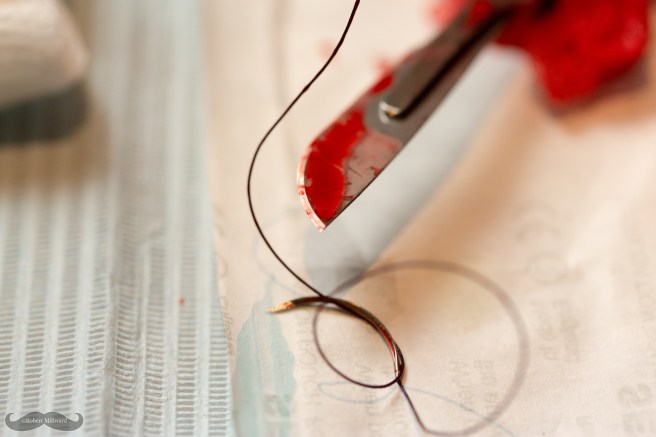
Because diabetic patients with wounds like these aren’t getting good blood flow to the area, tissues become necrotic and die. Necrotic tissue cannot be restored, and increases the risk for infection, so it must be cut away. In both patients, the doctor cut away any blackened, dead tissue until he reached the margins of healthy tissue. But then, interestingly, the doctor would continue cutting with his scalpel, into the healthy, pink, exposed tissue.
If an observer was watching the doctor and didn’t know what the doctor was doing, he might be horrified. Why make the patient’s wound worse and cause more bleeding? The reason for this practice was to enhance blood flow to the damaged area. By cutting into healthy tissue on the edges of the wound, more blood was allowed to enter, bringing in life-giving oxygen to help promote healing.
It sounds paradoxical…injure the patient to heal the patient.
I have found this same paradox to be present and true in our emotional lives. When we experience disappointment, grief, or trauma, even microtraumas, it is easy and instinctual to hunker down, close ourselves off, and resist any further pain. We want safety, and we often try to just stop feeling anything, because those feelings can be scary and they can hurt like hell.
But, to find our way through those things that initially hurt us, and to gain long-lasting healing, we have to dig back into those wounds, unpleasant as it may be. Wounds around our hearts can get hard and crusty over time. Sometimes we learn to protect ourselves by adding layer after layer of distractions, bad habits, and blame of others over those wounds to avoid feeling the rawness that lies underneath. The problem is, all those layers are necrotic, and they are a fertile breeding ground for bitterness, resentment, fear, and hatred.
We are going to get hurt in life. It’s inevitable and is a part of being human. What takes extreme courage is to allow for sacred wounds. I think sacred wounds are those that we self-inflict, or allow others to inflict upon us, as a healthy means to pursue healing. Sacred wounding happens when we take a scalpel (maybe through therapy, or bodywork, or introspection, or meditation, or The Work, or tapping, or countless other modalities) and begin to cut away at the tough exteriors that we’ve built up around our hearts.
Slicing anywhere near old emotional wounds is brutal, but when done with safe people in safe spaces, it can be transforming. Life and love, that are always within our deepest, truest selves, are suddenly able to start seeping out. They bring energy to those places within us that are struggling to breathe, struggling to survive. And those places start to vibrate once again, and begin functioning as they were intended. Over time, streams of life are flowing through those old wounds, where once it was stagnated in a toxic environment.
I once had several emotional wounds that I believed would never heal. They were just too deep, too infected, too complex. I was terrified of any scalpel that offered to cut away the hard callouses that I had built up to protect myself. Fortunately, I’ve learned that the Universe is a good physician. It brings the sacred wounding I need when I need it, and the result has been more healing than I could have ever imagined. Sometimes I still resist sacred wounding, fearful of the ensuing pain from whatever scalpel is being laid to me. But when I can summon just a small amount of courage, and lean into the discomfort, I only gain more life, an increased ability to love, and the flood of light into the deepest, darkest, most hidden places of myself.
Disclaimer: This post will likely not have anything all to do with science. Unless you consider the neurotransmitters in my brain that have helped me reframe and thus respond differently to Valentine’s Day than I have in the past.
I’m not going out tonight. I’m not getting flowers, chocolates, wine, teddy bears, or anything else colored red today. I’m not being romanced by anyone, nor am I pining away for anyone. I’m not listening to sappy love songs, and I’m not going to watch any cliche romantic Valentine movies.
And that’s perfectly OK with me. In fact, I’m great with it, and I harbor no resentment or ill will or jealousy towards anyone who will be happily engaging in the traditional Valentine’s hoopla. I think alot of the reason I’m fine with the current setup is that I’ve learned to change my perspective on what life brings me, and find the good out of what I used to categorically label as horrible.
There’s alot of people out in the world today who are hating Valentine’s or bemoaning the fact that Cupid must have been using a harmless nerf bow on them instead of getting it right and bringing them some great, true, faithful love. I completely empathize with people who aren’t having a great experience today, but I’d like to offer my own personal list of why I just don’t think Valentine’s is worth getting wrecked over.
Listed, in no particular order, except for maybe #1…..I’m happy to have a non-romantic Valentine’s day because…
1. I get to pick the bottle of wine tonight, and I don’t have to share. It’s a Chianti, by the way…
2. Meals at restaurants on Valentine’s Day are ridiculously overpriced and frequently underwhelming.
3. I am not a fan of the consumeristic, contrived expectations that come with Valentine’s. I mean really, how much do you have to spend on someone to prove your love?
4. If someone can only conjure up meaningful romance towards me on Valentine’s day, then there’s not much substance to our relationship to begin with.
5. Valentine’s day has always seemed to be a subtle game of comparison. Who gets what, how big is it, how expensive is it, how novel is it… . it’s just one more way for people, especially women, to employ ranking systems.
6. I personally am more thrilled when someone cleans my kitchen or randomly sends me an unexpected gift on another day, than all the froo froo that comes with Valentine’s. I don’t want jewelry…I want BOOKS.
7. Romance is fueled by obligation, guilt, or hormones. (Oh look, there’s some science!). Not to say there’s anything wrong with romance and the sweaty palms and beating hearts that come with it, but the state of being “in love” is unsustainable in the long term. We fizzle out after a period of time with the other person, and unless there’s some foundation that’s been laid beneath the hot romance, the relationship will struggle. It’s much more appealing to me to have a person who comes through for me 75% of the time and completely spaces Valentine’s day than it is for someone to blow Valentine’s day out of the water yet never really gets to know me or be there when it counts. Anyone can manage one day out of the year; the true test is the people that stick with you over the long haul.
8. I don’t get worked up over not having a fancy Valentine’s day because I am very well loved already. I have my tribe of people – the ones who have seen me ugly with bedhead and no makeup, the ones who have heard me swear like a sailor, the ones who know my deepest shame and worst failures, the ones who know my dreams and what I most fear, the ones who push me to be my best self, the ones who hold to me when I’m not a good friend and don’t love them back well.
The fact is, at some point we’ll all get ugly, we’ll all get saggy in spots, and maybe we’ll eventually stop making adequate amounts of sex hormones ,which will result in a lost interest in or physical ability to do romance anyway. But the thing that stays is our capacity to connect with others on a deeper, more meaningful level than romance or sex can take us. To truly know other people, and be known by them, will always be more important to me than whether or not I have a hot Valentine’s date.
9. Finally, I am my own best Valentine. I will never leave myself, I always look out for myself, I’m really good at picking out gifts for myself, it doesn’t take much to impress or amuse myself, and in general, I show up for myself when it matters. And when I get down deep to my core, past the ego and selfishness to my true self, I live and move and have my being in the great, good Love that connects all things.
There have been certain times in my life where the Universe seems to be trying to teach me about something. Either that or it is just alot of random coincidence converging on me in a short amount of time. Two particular cases that really stuck with me were the topics of baptism and the book of Revelation, back in college.
It seemed like every time I turned around during my junior year, the topic of baptism would come up in church, in lectures, in random settings. I could not get away from it. I now know every baptism related scripture verse, every possible understanding of the texts, and have probably heard almost all of the possible jokes surrounding baptism-like, does it count if you’re baptized in a mirage? Or, what if you drown while being dunked and don’t make it back out of the water before you die?
During the last half of college and for a while after, every time I turned around or visited a new church, it was all about Revelation. Pre-tribulation, post-tribulation, amillennialism, amillennialism with moderate preterite tendencies, Jesus rapture or no Jesus rapture…on, and on, and on. In many settings, my being unwillingly thrust into another Revelation experience was preceded by (read this in a sing-song, Southern accent): “We’re going to be doing a Bible study on the book of Revelations!” By the way, if you ever hear someone say the book of Revelations in regard to a Bible study, I can tell you with about 99% accuracy the specific content that will be covered and with what degree of literalism.
Was the Universe really concerned about my grasp of the various permutations in understandings of baptism and Revelation? Meh, I don’t know. But I can say this: whenever I attend a church who announces they will be covering either of these topics, I will decidedly not be showing up those Sundays.
On to the point of this post. I’m encountering another period where the same topic keeps showing up in my life from multiple avenues. Maybe it’s the universe, maybe it’s just because of the tribe of people I hang out with, the books I read, the podcasts I listen to, etc. This new idea that is hitting me from all angles? The need to show up for YOURSELF.
So, last night I went on a date. It turned out to be a date with myself and my 16 oz Blue Moon, because the guy that was supposed to meet me never showed up. Years ago, pansy, no self-confidence Julie would have been humiliated, feeling rejected, and completely anxiety-ridden about having to sit by myself at a restaurant. I would have told myself stories like: “He probably saw me from the window and took off.” “I bet he magically figured out from my online profile that I have nystagmus and he just couldn’t handle someone whose eyes involuntarily move ninety-to nothing.” “I probably screwed up again and miscommunicated about where and when we were supposed to meet.” “I’m a complete dork…of course things would go this way.”
In the past, I would have projected all kinds of stories onto the situation and ended up feeling horrible. But, because I’ve learned a thing or two over the last decade, and even the last month, and I have had people show up for me in life, this is how I responded to the situation: “Hmm, too bad for him…I’ll see if some of my friends are available to join me. Oh, they’re not. Well, hey! I get all the chips and salsa to MYSELF!” And I proceeded to chow down on the chips (which I’ll have to run off today) and enjoy my beer and….it was fantastic. I thoroughly enjoyed my own company.
Last night’s no-show was a great exercise for me to practice showing up for myself. Unlike unwanted insertions of more baptism and Revelation into my life that make me want to gouge my eyes out, I willingly embrace this learning to show up for myself. Because, myself is all there really is.
No, this is not me being narcissistic and thinking that everything exists for me. Rather, it’s about the three following ideas:
I’m the only one that will always be with myself. I will never leave myself, even when others come and go
My ideas about other people are really just my projection of my own beliefs and stories onto them.
People mirror back to me reflections of myself.
Point number 1 is pretty easy to grasp. We all know we’re stuck inside our bodies until we die…there’s no hopping around to other people, and we can’t really check out from ourselves.
Point 2: What we see and believe about other people comes entirely from our thoughts and perceptions about them. We can never REALLY know another person or their motivations. We can only speculate about them based on our thoughts. And just because a thought comes down the pipeline of our brain does not make it true, no matter how true it might feel. It is still biased and subjective on some level.
Point 3: Scientists frequently talk about mirror neurons in child development. They suggest that children learn behaviors and skills by watching the adults in their lives and then mirroring it back with the help of specialized “empathy” nerve cells. Anyone with children knows this phenomenon is true, both for good and bad. It’s super cute when your baby mirrors back peek-a-boo, but not so cute when they mirror back the “God dammit!” that you let fly out of your mouth when the toilet overflowed from excessive toilet paper insertion.
People mirror back to us what we believe about the world. If we see the world as malevolent and dangerous, we experience anger and danger from other people. If we see the world as good and abundant, we experience that abundance in our relationships and daily life. It’s all a matter of how we perceive things and what thoughts we believe about reality.
Back to showing up for myself. If I’m going to be the only one who is certain of sticking with myself through it all, and my life is really just about the stories I project onto it, then it seems like I need make myself a priority. Obviously, I’m not talking about doing whatever I want at the expense of others. What I’m talking about is getting to know and value MYSELF at the deepest level possible.
Our tendency is to worry about how others perceive us, and then mold and present ourselves in ways that will please them, or at least grant us some level of favor in their eyes. We frequently do this to the detriment of our hearts and betray our own core values. Which, when you think about it, is really kind of dumb when there’s no guarantee that those people will ever come through for you or stay forever, and what you think they think of you is probably a projection anyway.
The things I’m talking about here can feel kind of nebulous, and maybe won’t resonate with anyone. The first time I heard these kinds of ideas I thought it was alot of New-Agey crap. But the more I observe my own life, the more and more I believe that it comes down to me. Of course, I’ll pursue meaningful relationships, and I’ll do the best I can to really KNOW other people, and I’ll try to live my life in such a way that others are benefitted. But…in my mind’s eye I’m thinking of an asymptotic curve (you learned about these at some point in high school math). An asymptote is a line that a curve approaches as it heads toward infinity, but it can never quite reach that line. My analogy is this: we may be really, really accurate about the way things are and know about other people, but we can NEVER be completely accurate. And so I am left with this: I am the asymptotic curve. All I can really know is myself and where I am. I can never completely know anything for sure outside of me. And so, showing up for myself, and really being authentic to my core, and loving myself, is all there really is.
Others will leave you, but you will always have you. So, love yourself well, and make sure and show up every time.
I should recommend the book Loving What Isby Byron Katie. If you pick it up, the first time through you will think she is a nutty old lady who does not have a firm grasp on reality. But if you hang with her, what she says about only having yourself in life will start to make sense.
I’m becoming suspicious that my second-born son is a little mini-me. I’ve taken to calling him Preacher, because he is fascinated with anything related to God, as I was at the same age. He is definitely latching on to the evangelical Christian story, and feels the need to defend God at every turn. At Christmas he was offended when the local drive-through Christmas light event only paid homage to Jesus through one small display.
Part of me is thrilled that he has a spiritual side to him, a side that sees and is enthralled with more than can just be seen with the naked eye. But part of me is afraid for him. I fear the unlearning that he may have to endure as I did in my twenties and early thirties. I want to control the growth and evolving of his understanding of God and the divine: to protect him, to keep him from latching onto unhelpful dogma, to keep him from being the me of my own youth.
Inevitable in discussions with my son are conversations about the beginning of life. Just this week were visiting the Museum of Science and Industry in Chicago, one of our favorite places. In one exhibit, overhead were posted these words by Carl Sagan: “If we must worship a power greater than ourselves, does it not make sense to revere the sun and the stars?”
Preacher was quite upset by this, and told me that we shouldn’t be worshipping the sun or stars, but only God. This led into a discussion about the Big Bang, and I told him that when we are awestruck by what exists and has been created, we are worshipping God. Besides, I told him, we are all stardust. We should honor that from whence we came. This further vexed him, as he is still more well read in Genesis than he is astronomy.
My conversations with Preacher brought me back to questions I have been grappling with in my own spiritual introspection. The primary one I have dealt with of late is the struggle to accept reality as it is and then try to reconcile that with the understanding of a good Creator. I’m more of an atheist these days…I believe in a force that is holding all things together and is the essence of life, but I can’t swallow a truly theistic notion of God anymore. But despite this, something in me insists that this Ground of Being has to ultimately be good. I really have no clear, succinct arguments or empirical evidence for this…I just believe it in my bones.
Which brings the age old dilemma that millions before me have faced….how can bad things and evil be part of or come from something that is good? I don’t know. But I think maybe the Big Bang idea speaks of the goodness of this Ground of Being. I’m calling it the Great Allowing. My very limited understanding is that before the Big Bang, all the stuff that would soon explode outward was compressed into an immensely dense state….a state of extreme potential energy. And then boom…the universe burst forth and began its outward expansion and fusion created new elements and somehow over billions of years the right elements joined up at the right place in the right environment and life began. Freaking amazing when you think about it.
And then, it seems to me, God, the Ground of Being, let the universe take its course. Seemingly limitless possibilities were allowed. Maybe this galaxy would form over here. Maybe this would form over there. Maybe in this tiny corner of the galaxy the right circumstances would line up for a place called Earth to grow people. And those people will be subject to countless factors that will influence their lives and interactions with each other. And they will do horrible things to each other and the places they live, but they will also love dangerously and beautifully and sacrifice themselves for the good of others and those same places that they live.
What I’m trying to say is that it seemed like God sure took a huge chance when he decided to open Pandora’s Box of Big Bangs. The outcomes could be wonderful, or they could be disastrous. But he was willing that it happened. The Great Allowing commenced.
We all tend to think that we are dancers dancing life. But I like the way I recently heard Byron Katie put it, that we are the dance and Life is dancing us. Life is the dancer. Or what if, life is the Ground of Being, God, and he (sorry, English is lacking in good neutral pronouns) is dancing us.
I tend to be afraid to allow alot of things in my life. Control has been a great hallmark of all that is Julie, I just never recognized it until a couple of years ago. But….2017 was the most courageous year of my life. Some days I look back and am like, “Damn, girl! You ALLOWED a whole lot of stuff over the last year!” I allowed myself to face some of my biggest fears. I allowed myself to try hard things and dream big dreams. I allowed myself to love quickly, wildly, with abandon, when in the past I would have shrunk back into the shadows, afraid of being hurt. I allowed myself to say no, and I allowed myself to say yes. I allowed myself to dig deep inside myself to uncover more of who I really am…the things that I love about myself and the things I despise. I allowed myself to sit long with hard emotions, and I allowed myself to “Fuck it all!” on some of my really dark days. I opened my hands and allowed many things to land, and many to freely fly away.
This is what I learned from my own year of Great Allowing: I felt more alive than I’ve ever felt in my entire 37 years. I felt real, authentic, genuine…even if I didn’t always like certain aspects of myself. Everything seemed more meaningful, even though I had fewer answers about everything than ever. There were days I felt like a really great human, and days I felt like I probably sucked worse than any human that has ever lived, but at the same time, I felt like I could accept it because this is what being human is like, and this is what the dance looks like when life is dancing in a temporarily crummy person.
I do revere the stars, and the sun, because they remind me that whatever is behind life, Ground of Being or God or some clockmaker in the sky…it is not scared of letting go of all control, is not afraid of allowing whatever will happen to happen. If that same dancer, who wound up the tune of the universe and danced as the music box opened with delight, then somehow I believe I can trust life to dance me well, this tiny, insignificant little waltz in the corner of a spiral galaxy.
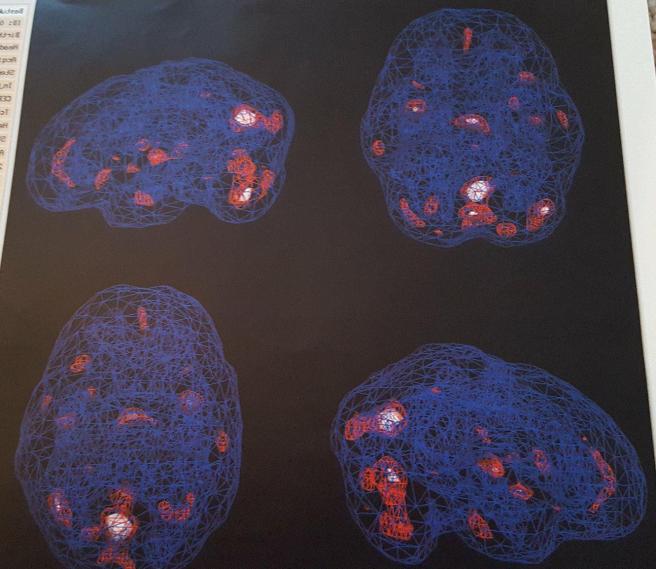
I have ADD. More specifically, I have the subtypes of inattentive ADD, anxious ADD, and overfocused ADD. And, I have the brain scans to prove it, courtesy of the Amen Clinic, my former upper-middle class status with fantastic insurance, and my white privilege enabling me to cross the country just to spend the weekend inside a SPECT machine. Nevertheless, I’m grateful to have been able to see what all is going on in the mess between my ears.
This is my brain without any stress or concentration. The white and red indicate activity. So, here my brain is functioning pretty well.This scan shows the activity in my brain when under stress or having to really concentrate. Much of the activity decreased in most areas of my brain.
Basically what these two particular scans are showing is that when I have to think really hard or am put into stressful situations, my head short circuits. At other times, I get hyper-focused and obsessive about certain thought patterns. Most of the time I’m able to compensate for this fairly well, and now that I understand what is going on, I can plan ahead for some of my brain farts. But sometimes, especially if I’m put on the spot with a question or task when I’m already nervous, I am left paralyzed and clueless.
Here’s an example. Last semester during one clinical, the nurse I was working with asked me what the classic signs of a heart attack are. We were taking care of a patient who was experiencing chest pains, and we were deciding whether or not she was really exhibiting heart issues or if she was just having anxiety.
When the nurse asked this question, I just went completely blank. I could not think and could not produce any kind of intelligent answer. It was so frustrating because the question was not a difficult one. This kind of scenario leaves me in a panic, frantically searching the databases of my mind and coming up empty. The result is that I feel completely incompetent, and it only increases my anxiety level, which makes everything worse. A second side effect of having these types of ADD is that I can be completely blind to things at time. If I’m nervous or stressed and am looking for something, I can literally not see it even if it is right in front of me. This phenomenon drives me crazy, to say the list, especially when it makes me look entirely stupid.
Over the last several years, I’ve been trying to incorporate practices into my life that will help calm my brain. ADD drugs have never been helpful for me…they make me hyper for a week and then stop doing anything. So, I needed alternative methods to help soothe my nerves, literally. I’ve found that doing yoga and sitting meditation have helped tremendously in this area, because they force me to be where I am at that moment, and only focus on what is right in front of me. I have also learned that if I get less than eight hours of sleep at night, the next day will include multiple episodes of brain freeze.
There is a word play off an old adage that goes “Don’t just do something! Sit there!” This mindset totally goes against most of our natures. We believe that to solve problems or change things, we must do, do do. I totally fall prey to the mindset that I will find my answers externally, and if I just work harder or find the right book or talk to the right person, or, or, or…I will discover the solution to my problem. The same happens when I’m having one of my ADD attacks. Instead of leaning into the discomfort of my brain momentarily shutting down and letting it calm itself, I internally panic and start grasping for anything to help me feel right again. This never fixes anything, and only exacerbates my anxiety, which then lengthens the time my brain is out of service.
What I’m gradually learning over time, but still regularly forget, is that when things blow up in our faces, the best thing to do initially is to not react. We need to just sit there and look that situation or person head on without judgment. Because when we jump into action straightaway without letting it be, we are acting out of our beliefs and thoughts about that situation or person, and our thoughts may or may not be true. Or, as in my case with ADD and I literally have NO thoughts that will come, I’m just reacting out of habit and knee-jerk reflexes, which have never been helpful in these circumstances.
It is better to sit and watch and understand before we try to do anything. Then, with time, out of a calm and relaxed mind, we can make balanced decisions about how to proceed, without being motivated by fear, or for me, blind panic.
“To meditate means to go home to yourself. Then you know how to take care of the things that are happening inside you, and you know how to take care of the things that happen around you. “
“The sacred sense of beyond, of timelessness, of a world which had an eternal value and the substance of which was divine had been given back to me today by this friend of mine who taught me dancing.”
― Hermann Hesse
I woke up in the middle of the night last night with a serious panic attack. I was thinking I can’t make it and everything I’ve worked so hard for over the last year and a half is going to crumble. It’s tough co-parenting with an ex, and scheduling school and work is an exercise in trying every permutation possible with a limited number of hours and days available to me. Will my money hold out? Am I making good decisions? And I sure hope I still like nursing at the end of all of this.
Of course, my panic attack might have been precipitated by having a little too much Fireball when I was already tired and stressed. Anyway…
After my hyperventilation and near-crying episode, I fell back into a dream where I was ballroom dancing on a stage with a man I’d never met. We were performing before an audience that I couldn’t see because of the bright stage lights, and while dancing I was thinking to myself…what the hell am I doing here? I don’t know how to dance! But somehow I trusted his lead, and we danced and twirled and dipped. The dancing in my dream wasn’t imagined. I vividly recall a full five minutes of being part of an actual dance. I was charmed and laughing and allowed myself to be spun around the floor with little concern for what the audience thought. My partner was laughing as well, and whispering throughout the dance about how great we were doing. I don’t remember getting tired or feeling uncertain. It was kind of magical, as dreams can often be. The guy in my dream also resembled Rob Thomas wearing trendy glasses, so that imagery didn’t hurt either.
I woke up this morning thinking about that dream, and wondering if it was a metaphor about life. Maybe my subconscious was reaching out to me with encouragement? Maybe it was the Fireball? Either way, I thought about the possible meaning of this sleep experience all day. If I had fought against the partner in my dream, insisting that I didn’t know what I was doing and was going to make a fool of myself, the dance would have been ruined. But instead, I moved into his arms and let him guide me where we needed to go, and the result was effortless and pure joy.
Life is hard as shit sometimes, there’s no doubt about it and it doesn’t always feel like elegant, graceful choreography. There are so many things I wish I didn’t have to go through, and so many times when I fight and scream and absolutely make a fool of myself trying to avoid pain and hard things. But if I’m honest with myself, life has been good to me. I have changed so dramatically over the last ten years in ways that I once thought were impossible. I’m braver, more authentic, and have a greater capacity for love, even if I’m still learning what that really means. So, I will keep trusting and trying to lean into this partner of mine that is life, who is patiently teaching me the steps to an enchanted dance.
When I went off to college, I felt pretty certain that I understood the way life works. You ask Jesus into your heart, live as morally pure a life as possible and ask forgiveness for all the rest of the crap you do, memorize copious amounts of Scripture, pray as much as possible, and trust God for everything else. This is a pretty simplified version, but you get the gist.
Now, almost twenty years later, there is basically nothing that I am certain about, for absolute certain. All the rules to the game I once played no longer make any sense. In fact, I think I’m playing a different game with rules that feel impossible to completely grasp.
I’ve been reading Zen and the Art of Motorcycle Maintenance again today, and one idea really stood out to me.
What is the truth, and how do you know it when you have it? p. 126
Because I’m finding, as Pirsig suggests in the book, that questions beget questions. As you find answers you are really no further along in your journey because an infinite number of other questions arise at the same time. He describes it this way through his fictionalized character’s exploration into the scientific method :
“He [Phaedrus] had noticed again and again in his lab work that what might seem to be the hardest part of scientific work, thinking up the hypotheses, was invariably the easiest. The act of formally writing everything down precisely and clearly seemed to suggest them. As he was testing hypothesis number one by experimental method a flood of other hypotheses would come to mind, and as he was testing these, some more came to mind, and as he was testing these, still more came to mind until it became painfully evident that as he continued testing hypotheses and eliminating them or confirming them their number did not decrease. It actually increased as he went along.” p. 112
And…
“In the high country of the mind one has to become adjusted to the thinner air of uncertainty, and to the enormous magnitude of questions asked, and to the answers proposed to these questions. The sweep goes on and on and on so obviously much further than the mind can grasp one hesitates even to go near for fear of getting lost in them and never finding one’s way out.” p. 125
I don’t claim to be operating out of the high country of the mind like brilliant people such as Pirisg, but I have definitely felt the getting lost-ness in the ever expanding stream of questions in my mind. My spiritual explorations definitely have a Phaedrean quality. It also seems like my striving to answer all of these questions is a race that is getting faster and faster. I feel manic at times and completely clueless about where this trip is taking me.
“Phaedrus wandered through this high country, aimlessly at first, following every path, every trail where someone had been before, seeing occasionally with small hindsights that he was apparently making some progress, but seeing nothing ahead of him that told him which way to go.” p. 127 (If you haven’t read the book, Google Phaedrus…or just insert my name in his place, because I see myself in this passage.)
My racing down every path trying to discover truth first really began when I finally concluded that I categorically do not believe in hell or Satan. Since I no longer had a tidy solution for all of life’s problems, I frantically began a search for meaning in life. I started slow…OK, so if there is no hell, does everyone go to heaven or are evil people annihilated and cease to exist? Then I moved on to whether or not atonement theory and our modern understanding of Jesus and the resurrection story made any sense. Next, I questioned whether or not stories in the Gospels were actually literally true. Then, a critical look at the Old Testament. Then on to readings in Buddhism, Taoism, Native American spirituality, Christian mysticism,, Sufism, Cabbalism, and a tad bit of pagan thought. Throughout all of this exploration down various spiritual avenues, I have tried and am still trying to see how science, psychology, and the natural world fit in. The questions keep coming from every direction and I chase answers down one path, and then down another, and then down yet another.
“And so he (or Julie) wanders blindly along one trail after another gathering one [puzzle] piece after another and wondering what to do with them…” p. 127
Are there any ultimate answers? Do these puzzle pieces we get in life actually fit together somehow? Is there a destination to reach at some point?
In physics, there is a concept referred to as the Heisenberg Uncertainty Principle. I’m not a physics expert, but basically the idea is that you can’t precisely know the exact position and momentum of an object at the same time because things in the universe have qualities of waves and also of particles. If you want have a good understanding of an object’s exact location, you’ll have to be OK with being less certain about it’s speed and momentum. On the flip side, if you want to get more detailed information about an object’s momentum, you’ll have to content yourself with being less certain about where exactly in space the object lies.
I feel like maybe this is the way truth is, and consequently, all the answers for our questions. We want to pin truth down and say, “Aha! Here it is, I’ve found it! And it’s just like this in all situations for everyone at all times.” We may find a preliminary answer, a puzzle piece, but the truth squirms away from our pointed fingers and we discover that other variables aren’t so clear anymore. A hypothesis: the uncertainty principle of truth:-we cannot simultaneously know something to be true for everyone in all situations at all times.
I don’t completely believe this either, because I think that LOVE is absolute truth. But this just brings up more questions….is LOVE real? Or just a by-product projection from neurotransmitters in our brains and a function of the survival of the fittest and evolutionary adaptation? I’m leaning towards the former, that LOVE is real and transcends everything, but I’m not entirely certain. Besides, the idea of LOVE is a squishy notion that can be about as hard to pin down as an atomic particle. For example, something may look like love on the outside and may benefit someone or something, but be created out of selfish motivations or means. Vice versa, something may not look loving by outward appearance but come from very good motives and means. Uncertainty, indeed.
Sometimes people wonder why I even bother to go to church anymore. I mean, I’m clearly not in the Christian mainstream. For that matter, why do I go to a Zen Buddhist meditation group when I’m not hardcore Buddhist either? I’m a little bit atheist, too, when it comes down to it.
I think I believe that all of the puzzle pieces I’m picking up day by day have a little bit of ultimate truth in them; I just have to be careful not to insist I understand everything about them at one particular point in time. I can’t get all the pieces to fit together yet, and I can’t see the big picture on the puzzle box, which would be helpful. But I need people to do life with, people who are also searching and feeling uncertainty and who know that they don’t understand it all. Every group that I’ve ever encountered that is asking hard questions about life had a mix of great insights and big blindspots. So, you do your best to find the people that help you stumble down the path you are on until you reach the next path, and there will be a new group of people to lead you down that one-people that help carry you through your uncertainties.
And now, I propose the Uncertainty Principle of Julie: I will inevitably squirm out of labels that are put on me and show up where you least expected it. I’m Christian, but I”m not. I’m Buddhist, but I’m not. I’m a humanist, but I’m not. I’m just a strange bundle of uncertainties that is me.
A friend of mine gave me a copy of Zen and the Art of Motorcycle Maintenance for Christmas. I had picked the book up by accident way back in college when I mistook it for a required text for a particular class. Instead of returning the book, I tried to slog my way through it. Needless to say, at the time I had absolutely no idea what Robert Pirsig was trying to say. After a valiant attempt to decipher his thoughts, I gave up and toted the book off to Goodwill.
But this time around, almost two decades later, the book came alive to me within the first few pages. I even hauled it to work with me to read during my break. Pirsig is giving verbiage to nebulous ideas I had circulating in my brain but could never pin down, never sink my teeth into. I suspect many of my future posts will be referencing this book, which is destined to become one of my favorites.
I’m about a quarter of the way through the text right now, and came across a passage that brought with it a wave of “Aha! This!”. To explain why, let me give a little back story. Until I was in my early 30s, I was a devoted Christian, fitting well into mainstream evangelical culture. I believed in the virgin birth, the literal resurrection of Jesus, and was convinced that in some form or fashion, Jesus would return and transform all that is ugly and broken. I did have a few nagging doubts during those years, concerns that could never quite be reconciled. But, hey, if my mother, who was a physicist and professor, could hold the enormous paradox between a literal understanding of the Bible and what she knew to be true of the cosmos, who was I to interject my uncertainties?
I ran into problems when I discovered that many of the “Christian” precepts that had ushered me into adulthood through a safe, and albeit, naive childhood, were no longing serving me well. In fact, I was wondering if some of them had ever served me well at all. I began to ask hard questions that I apparently had hidden in my subconscious-cautiously at first, and then headlong with abandon. The result: I killed Jesus. At least, I killed the projection of Jesus that I had carried with me for so many years. The Jesus I had prayed to, the Jesus I had worshipped, the Jesus I hoped would save me from some eternal damnation.
In the pages of Zen and the Art of Motorcycle Maintenance I stumbled across this:
“When analytic thought, the knife, is applied to experience, something is always killed in the process.” p. 81
In my case, the analytic thought was the science and logic that I know to be true from my education and continual learning. This knife broke down my theological scaffolding, and the Jesus I believed in who was teetering, precariously, came crashing down with it. I grieved this dead Jesus, because he had been my everything for thirty-some-odd years. All that I did and all that I believed myself to be centered on this story of him. But Pirsig also describes what I began to discover over time:
“And instead of just dwelling on what is killed it’s important also to see what’s created and to see the process as a kind of death-birth continuity that is neither good nor bad, it just is.” p. 81
The fact is, I could have gotten stuck at the death of Jesus in my mind. I could have gotten angry and cynical and believed that since there is no Jesus anymore, life is pointless and haphazard and completely impersonal. But with the help of writings from Marcus Borg and Joseph Campbell, I began to see that me killing Jesus was necessary to rebirth him in my mind as something bigger and beyond all the petty little questions I had been asking in the first half of life. So many of those questions stopped being questions I really cared to ask.
Campbell said if you’re going to fall, you might as well make it a voluntary act. So, I went with it and found that the abyss I thought I was falling into was actually a wide spaciousness that caught me. And that expanse birthed a new Jesus for me.
No longer is Jesus the only saving resurrection story. Rather, he is the archetypal human that revealed to us how we must die to enter into real life. As Richard Rohr has remarked, the death and resurrection story of Jesus shows us the growth and change pattern for all of life.
The new Jesus story I cling to is so much richer than the one I used to recite to myself. Jesus is now to me someone who worked to overthrow the domination system with a non-violent ethic. He was someone who died repeatedly to his ego and lived out of his true self, leaving us an example of how to do the same. He was someone who lived in such union with the divine within himself, that one couldn’t tell where his humanity ended and divinity began.
The primary reason that this resurrected Jesus means so much more to me is that I am no longer enmeshed in a belief that I am inherently a horrid creature in need of saving by some external being. This new Jesus has shown me I only have to go inside of myself to find all that I need, and that at my core, I am light. And at the same time, I no longer have to be afraid of the darkness. It all belongs. Death and crisis and tragedy are transforming agents that let the light in, and grace is the vehicle that carries them all.
I now happily wield my analytic thought knife, and allow others in my life to slash away at beliefs I am clinging to with their own knives. The person who gave me Zen and the Art of Motorcycle Maintenance has been stabbing away at me, and I welcome it. I’m not so afraid any more of dying things, or of dying myself, because I know that life is ever on the other side.
“The secret of life is to die before you die – and find that there is no death.” -Eckart Tolle
This is a mosaic essay I wrote a couple of years ago to try to flesh out my own fledgling understanding of how space and what appears to be nothingness play into reality. It offers, I think, a good introduction for this blog and represents many of the questions swirling around in my head.
The Surreptitious Subtleties of Space
To find true understanding, says renowned Buddhist monk Thich Nhat Hanh, one must look deeply into the nature of things. Science, religion, art, and music all attempt this with unique methods, and each reveals insights gleaned from the depths of reality. These fields offer us glimpses of the universe, perspectives from various vantage points. Their relationships could be likened to overlapping circles, influencing each other as they reveal different angles on truth, yet each still remaining autonomous.
***
It is 1987. I am seven years old, standing outside on a warm summer evening, watching the twinkling lights in the black night sky. As I watch, something begins to rise up within me. It starts as a small tendril of fear, winding its way up through my chest. But quickly it becomes full blown terror, snaked round me, suffocating and paralyzing. In my childish mind, already steeped in fundamental Christian teachings, I somehow equate the expanse of outer space with the limitless, endless nature of eternity. Cold, dark, lonely, unknown. My panic drives me back into the safe, well-lit confines of my parents’ house.
***
Scientists and mathematicians often wonder if we humans invented mathematics, or merely discovered it. Is God the original mathematician, creating the universe based on laws and formulas that he dreamed up? Is mathematics an autonomous entity unto itself? We have no hard answer for this, but advances in so many fields, including genetics, neurobiology, and even anthropology, were possible because of pathways mathematics has laid out for us.
Mathematics is essentially the exploration of different types of dimensional spaces, each prefaced by one of a myriad of adjectives. Topographical space, noncommutative space, two dimensional space, linear space, and so on. In this field, space is understood both concretely and abstractly. When we study geometry, it is easy to identify spaces created by vectors, various points that create a structure, and graphical representations of objects that may or may not be real. But each of these spaces can be described through algebraic equations and formulas, which allude to the important relational nature of all that constitutes space. Most of us learned Euclidian geometry in school; it best describes flat spaces, those that are one and two dimensional. This type of math remained unchallenged until the late 1800s with the development of Riemannian and hyperbolic geometries, which apply to curved and saddle shaped spaces.
Mathematicians also love to work with numbers that don’t exist, that are basically formless and non-existent, a type of empty space in themselves. The introduction of zero in antiquity transformed mathematics, and later, the introduction of imaginary numbers propelled complex math to a new level. Imaginary numbers are found by taking the square root of a negative number, denoted as i, for imaginary. Originally, no one knew if there would be a real world use for these fantastical numbers, but they have proven very useful for fields like quantum mechanics, fluid dynamics, and electrical circuit theories.
***
The God of my youth had a violent temper until he was apparently placated by the horrific death of Jesus. Afterward, he became safe when approached through contracts and formulas. I was taught very clearly what God likes and does not like, and as long as I adhered to his laws and principles, I would be shown mercy. Within specific boundaries, God was warm and loving, but cross the wrong line, and he would be sure to put me on the bullet train to hell.
Geometry class came easily to me in school. I liked the boundaries it imposed on space, probably because of my understanding of God. Triangles, rectangles, and circles…all bounded in with limits. They were measurable, tangible, and for most of the work I encountered, finite. In my mind, the absence of boundaries threatens safety. It invites in the unknown and the opportunity for unwelcomed change.
In college calculus class, we dealt regularly with infinity (∞) and negative infinity (-∞). I approached these numbers with the same disdain and fear as the cosmos. How could numbers grow forever in a positive or negative direction? My mind, that held fast to the belief in a theistic God, could not fathom how something, even an abstract mathematical idea, could seem to carry on without limits, as though it was a god.
***
The space beyond the confines of our atmosphere seem like inky-black nothingness, spotted here and there with galaxies, but it carries countless secrets that puzzle its admirers. The galaxies are not simply floating along in a great cosmic dance, but are rushing away from each other with increasing speed. Stars on the edges of these galaxies travel much faster than astrophysicists would expect, according to traditional physics models.
Galactic rotational curves have provided evidence for this baffling enigma. These curves help describe the speed at which stars travel around the center of a galaxy. Models that predict these velocities consider the relationship between distance with gravitational forces and suggest that stars in outer orbits should move slower than those in inner orbits. In reality, the change in velocity is flat. Stars that are on the outer edges of galaxies move just as fast as those in the center.
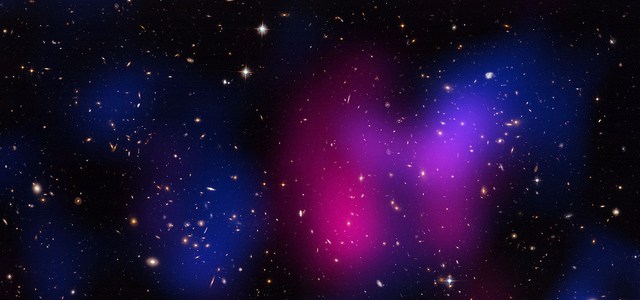
Scientists believe there must be some sort of scaffolding supporting this cosmic machine, but what is it? Perhaps dark matter. There must also be some phantom energy pushing the universe apart to explain the increasing distance between us and faraway stars. Dark energy? Both are speculative but increasingly accepted theories, and both seem to have qualities that surpass anything that visible matter and detectable energy possess. Scientists postulate that dark energy and dark matter make up 95% of the known universe that we perceive as empty space. That means the earth, stars, and matter and energy that humans can detect only make up a measly 5% of all that falls within the boundaries of what we can currently comprehend.
***
Humans take up an infinitesimally small amount of space in all that exists. We believe ourselves to be grand, but we are simply stardust, appearing as a clustered blip in the history of time. As an adult, I stumble over the theories of dark matter and dark energy. I try in vain to reconcile how this God I think I believe in would spend so much time crafting the cosmos, simply to focus on a small heaven or hell morality game with a tiny sample size of what he made.
My faith is beginning to waiver, but a tiny flicker of hope rises up within me: maybe life is bigger than what I once thought, maybe the reality of God goes much further than the reductionistic ‘accept or deny Jesus’ decision I felt forced to make. Maybe we’ve got it wrong and the only reason we thought God was angry was because we didn’t always know how wonderful the cosmos is? Maybe the life of Jesus was just a strike-through of all the anger we thought was harbored against us?
***
As they peer more closely at subatomic particles, scientists have discovered in the last century just how spacious an atom really is. A hydrogen atom, for instance, is a little over 99.9% space, leaving ample room for electrons to dance and spin, disappear and reappear, all around the atom’s nucleus.
But in reality, all that seemingly empty space in the atom isn’t really empty. Quantum field theorists suggest that the “space” varies in energy levels, and even at its lowest energy level, can generate elementary particles. As it turns out, to create a true vacuum of nothingness, if it were possible, would itself require an immense amount of energy and ultimately be very unstable.
***
The near impossibility of creating a true vacuum of nothingness, at least in this universe, is very encouraging to me. Nothing is truly dead, or lost. Oblivion and nihilism are fanciful ideas. From emptiness, stars explode into being. From stardust, life bursts forth. Because there is hope in the universe, there is also hope for me.
***
The spaces in which we live and work, and how we fill those spaces, play an important role in our lives. If our rooms, buildings, and living areas did not somehow impact our sense of emotional well being and aliveness, then we would expect them to simply serve us in a utilitarian fashion. We would construct buildings and fill spaces with materials that are simply functional, with little concern for aesthetics. But we as humans, when unconstrained by external factors, are not content with mere functionality. We want to fill the places that we spend our time with beautiful things that engage us spiritually, mentally, and emotionally.
The Chinese philosophy surrounding Feng Shui is built on the foundational premise that spatial arrangement is important. Modern Westernized Feng Shui involves maximizing optimal arrangement of items in interior spaces to improve the flow of qi, or life force energy. Several more traditional branches of the philosophy approach the flow of qi in a scientific manner, using complex mathematical calculations, numerology and polarity to ascertain the most favorable or unfavorable ways to frame and fill spaces.
***
There is a verse in the Bible that describes God as the one in which “we live and move and have our being.” When I consider the cosmic racing of the stars, the inner creative worlds of atoms, and our own innate need for aesthetics, I can’t help but read this verse differently. What if God is mostly about process, relationship, and interconnectedness? What if God is the energy moving in all the spaces in and around us?
***
Artists understand that their craft is not only knowing what elements to include in their work, but which elements to leave out. Frequently, what is absent offers our imaginations room to flourish, license to go deeper and move beyond the superficial. Space plays a crucial role in art composition. In this context, it can be described as positive or negative. Positive space in a piece of art refers to the shapes of interest, the subject at hand. Negative space, meanwhile, is the space around the subject of interest that provides an artistic effect and offers breathing room from clutter in the composition. When utilized well, the negative space in a painting or photograph is capable of bringing the piece to life, generating a compelling attraction for viewers.
The Japanese also speak of the possibilities that can arise from negative or empty space through a concept they call “ma.” Ma is a pause or gap between two elements, but it is not limited to a tangible, dimensional sort of space. Rather, it extends to the level of experience and imagination. It is not oblivion, but a formless origin that is pregnant with possibilities. A poem from the ancient Tao Te Ching describes the idea of ma well:
“Thirty spokes share the hub of a wheel;
yet it is its center that makes it useful.
You can mould clay into a vessel;
yet, it is its emptiness that makes it useful.
Cut doors and windows from the walls of a house;
but the ultimate use of the house
will depend on that part where nothing exists.
Therefore, something is shaped into what is;
but its usefulness comes from what is not.”
***
I’m learning to meditate, to focus on the breath. There is a saying: “Don’t just do something! Sit there!” It is hard to just ‘be’ and make space within myself. The fury within me prods me to get up and ‘do’, and stop wasting time. Prove yourself! it nags. But again and again I force myself to sit, and breathe, and try to trust that what I am not doing is as useful as what I do.
***
Music is one of humanity’s universal languages. It touches us, moves us, stirs up memories from the past and passions for the future. Claude Debussy defined music to be the space between the notes, not the notes themselves. Philosopher Alan Watts echoed these sentiment decades later when he said that we only hear melodies because of those spaces. It is the combinations and patterns of notes with silent gaps between them that result in melodies, harmonies, and rhythms that can be distinguished from each other. The length that each note or space is allowed to continue influences the mood and tone of a piece.
However, it doesn’t seem to just be the random pauses between notes in pretty melodies that affect us. Many alternative medicine practitioners are convinced that music has healing capabilities. The energy from each note or combination of notes travels through physical space as sound waves, and these vibrational waves can affect a person’s emotions. For instance, a minor second chord creates feelings of tension or unease, while a major third produces feelings of hope and sweetness. Some ‘healers’ are convinced that the vibrations sent out by music can even help align one’s bodily energy fields, resulting in greater physical well-being.
***
I’m beginning to accept that space is not simply empty nothingness. In both the metaphysical and tangible senses, space is the creative potential from which life, form, and all that is meaningful spring forth. I remember that the late theologian Paul Tillich once described God as the Ground of Being: not personal, but not less than personal. Could it be the that space in all forms is this Ground of Being?
***
The Western spiritual teacher Eckhart Tolle has said that our essential nature as beings is not content, not form, not the things we do or what we achieve. Our identity can be known, but not conceptually, because concepts again bring us back to names and forms. Instead, identity, our true self, can be known in the space of stillness. “The best description through words is to say what it is not, and then you are left with what it is. It cannot be named, but it can be known. But not known conceptually, because again, every concept is a name, a form. It can be known simply, easily, in the silent space of stillness,” says Tolle. These spaces, stillnesses, between words and thoughts, are the canvas upon which existence is painted. They are vibrant with life.
Tolle’s words, and those of countless other spiritual masters who resonate with him, sound remarkably similar to what physicists tell us happens on the quantum level. Existence and matter rise from what seems to be void.
***
It is 2015, and I can now gaze into the night sky with wonder and appreciation, instead of dread and panic. I no longer see it as a great empty expanse, but instead, a magnificent fullness.
I’m discovering that my old belief systems are no longer serving me well. The theological scaffolding that has stood in place for the first three decades of my life is crumbling, but I no longer fear my foundations being knocked out from under me.
I’m freefalling through space. Or, perhaps, I’m being caught by space.









 Scientuality