
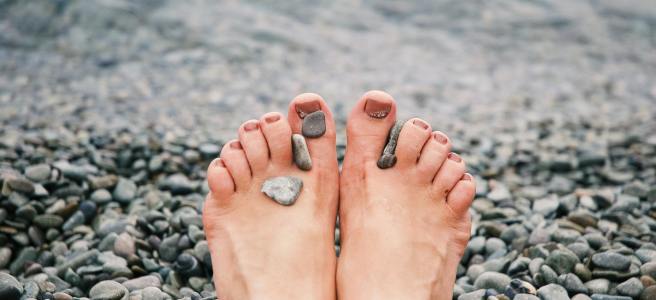

Last weekend I went and got a manicure and pedicure…the deluxe version that takes 2 hours. This has become a regular self care activity for me thanks to a couple of my coworkers who totally got me hooked on it last year. Following the completion of a 50k trail race back in March, my feet were in TERRIBLE shape and missing a couple of toenails. I wasn’t sure there was going to be much coming back from that foot trauma for a while, but as usual, the nail tech at my favorite shop worked his magic and made my feet look good enough again to embrace sandal-wearing and barefoot walking in public this summer.
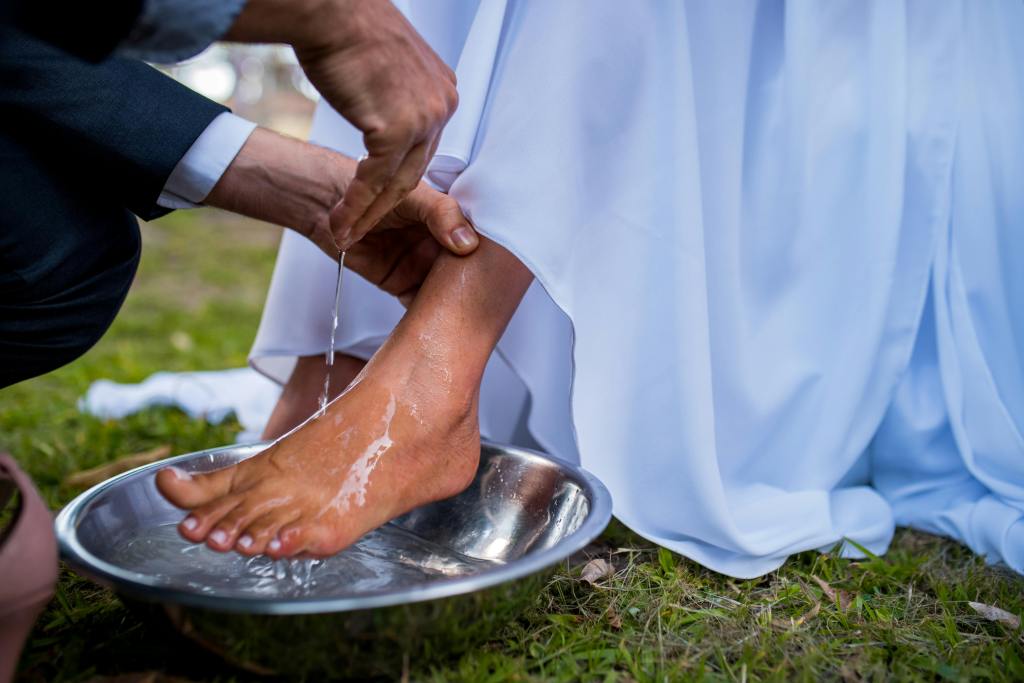
While I was sitting in the massage chair, being vehemently kneaded in the back and having warm, lavender-scented foot scrub rubbed into my feet and legs, I started thinking about the stories of Jesus and foot washing in the Gospels…you know, as one automatically does when getting a pedicure. In John 13, Jesus wrapped a towel around himself, a sign of meekness and submission that would be totally unexpected from a respected rabbi, much less the Son of Man, and began to wash the feet of his disciples. Simon, the feisty disciple out of Jesus’ 12 followers, initially adamantly refused to allow Jesus to wash his feet. To which Jesus tenderly rebuked him and explained to him that his (Jesus’) message was that we are to serve each other, even in the lowliest of things, like washing the mud and grime and who knows what else from dirty feet. None of us is worthier or more important than anyone else, no matter our privilege or status.
When I was growing up listening to sermons on this story, and then as a Bible major in college, emphasis was placed on the importance of humbling oneself, letting go of ego and sense of status, and being willing to serve the least among us…those in society who may be considered unworthy, or untouchables, or generally “other” and beneath us. This interpretation is certainly a good one, and obvious from reading the gospel text; we all need to learn the lesson that we are interconnected and equally deserving, and it is good for us to learn to set aside our personal preferences and sometimes embrace any “ick” we perceive in various situations so that we can offer love and service to others. But as I was getting my feet tuned up during my pedicure, I flipped the storyline in my head and for the first time viewed foot washing from the perspective of the person having their feet washed. Foot washing, both literally and metaphorically, is a humbling and helpful practice for the washer, especially if they come from a stance of privilege and status and wellbeing. But just as, or maybe even more important, is the ability of the person having their feet washed…to allow it. Which made me think that maybe the whole point of foot washing (or general service and outreach to others, moving beyond this metaphor) is not to just reach out for the feet all those who are brave enough to strut up and stick a foot out… Maybe foot washing is about humbling ourselves to not only serve others, but also to do the harder work of gently and carefully coaxing out the ones who desperately need their feet washed but are too ashamed and afraid to reach for that help.
********************************************************************************************************
For a huge chunk of my life, I had major shame issues around my feet. It’s not really relevant to go into details about why, but let’s just say it significantly affected me for a long time. Decades. As an adult, I largely got over the shame issues because they were related to a bunch of other topics I addressed in years of therapy and shadow work. However, about the same time I started getting over those shame issues, I became interested into long distance running. My toes and toenails have never been quite the same since. It took me running several marathon-length distances, especially on trails, to realize how much my feet swell at certain distances, and that my running shoes need to be at least a 1/2 size to a full size larger than the shoe size I typically wear on a daily basis. Even with bigger shoes, long distance trail running, with repeated downhill stretches, cause one’s toes to slam repeatedly into the front of the shoebox. Inevitably, blood blisters develop underneath your toenails and eventually some of those toenails will just give up the ghost and fall off. Big toenails will half break off and then never grow back quite normally; instead, they grow out thicker and with ridges.
This loss of toenails from running used to really bother me; I mean, if you’re wearing sandals during the summer and you’re missing toenails, people might not instinctively ascertain that you’re a runner and you legit earned those toenail losses by pounding mile after mile of pavement and single track. But I’m getting over this, and learning to just suck it up and ask for help in making my feet presentable. I was reluctant to go in to the nail salon the other day because of two of my missing toenails, but I did anyway, and wouldn’t you know…my summer feet were salvaged.
Now, I know that no one reading this really cares about my toenails, their color, or what shape they are in. And that’s really not the point of this post. The overall premise that I want to explore is how shame keeps people from asking for help from the people who can give it to them. And, on the flipside, the foot washers…the people who are capable of offering help….must learn to see the offering of help as an artistic practice that must be guided by empathy and love, intuition, and really good boundaries.
**********************************************************************************************************************
Shame is the greatest cause of debility and loss of a sense of self-agency in life, in my opinion. The worst part about it is that it is often hidden behind masks of the people who carry it. Behaviors that result from shame in one’s life are so frequently misread and misunderstood by others, often leading to the shame-filled person being labeled as angry, or frigid, or snobbish, or aloof, or bitchy, or weak. It’s all the worse when the person driven by shame doesn’t KNOW they are driven by shame. To top it off, we have unspoken rules within cultures that prescribe who is allowed to admit and express that they are filled with shame, and who are told to just suck up their emotions and insecurities and get on with life. Thanks for the good reminder, Brené.
Undealt-with shame can lead to depression and other mental health disorders, anger/rage, and physical un-wellness…both as a result of self neglect and because the body has stored up trauma and unprocessed emotions for so long that it is forced to eventually express itself in the form of illness or the general manifestation of negative external events. Think The Body Keeps The Score and When The Body Says No. Even with my short time working in healthcare as a nurse and now nurse practitioner, the link between childhood trauma, complex PTSD, and the presence of autoimmune disease is so strikingly clear and obvious to me on a daily basis. But even more than autoimmune process triggering by environmental and interpersonal influences from one’s past and current circumstances, I see people who are struggling with poor health (emotional, spiritual, and physical) because they didn’t know that help was available, didn’t know what questions to ask get the help they needed, or they felt so unworthy and ashamed to ask for help, that their health issues piled up over time, eventually resulting in major un-wellness and disease in their bodies.
************************************************************************************************************************

************************************************************************************************************************
The first time I saw a truly diseased foot was when I was a brand new nurse working on an ortho/trauma unit. I was in my late 30s by then, but really had little idea at the time how devastating diabetes could be to people’s extremities, especially their feet and toes. One of my patients on that unit, in my first few months of nursing, had a foot with completely necrotic toes. They were black and leathery and I remember being horrified when I was told that the physician caring for the patient expected the toes to “auto-amputate”…basically fall off on their own. In the meantime, I was to apply betadine to the toes on a daily basis to help prevent infection…my own literal task of foot washing, if you will. I had that patient for several days and prayed each day that his toes would not “auto-amputate” during my shift. I also recall wondering how and why a person could let their feet get to that terrible of shape before seeking help.
Since those first few months as a nurse, I’ve seen a ton of foot and lower extremity disease. Now, working in Infectious Disease as a nurse practitioner, I see patients with foot infections everyday, mostly resulting from uncontrolled diabetes or poor vascular flow to their lower extremities. I recall one patient who initially came to the hospital with cardiac concerns; but due to an odd smell coming from the patient, the attending physician pulled off the patient’s socks to discover a foot that was over half necrotic….tar black in color….that ultimately required a below the knee amputation. The situation was really sad, because if healthcare providers had been aware of the problem and able to intervene much sooner, the patient probably could have had at least some blood flow restored to the foot and avoided such a significant amputation.
So many people intersect with the healthcare system far too late to prevent or reverse many of their health problems. And while the reasons for this are usually complicated and numerous, I have seen countless situations where intense shame and embarrassment and a lack of self agency prevented people from reaching out for help until they were desperate and had no other choice.
************************************************************************************************************************
So how exactly is the act of metaphorical foot washing, or serving others who are shame-filled and desperately in need of help, an art?
I think the primary answer is that humans cannot be approached through a reductionistic, mechanistic model and be expected to achieve sustainable wellness.. Based on what I can tell and have experienced in my life, humans are complex, nuanced, layered beings who are not just a bunch of parts and systems that function together, although unfortunately, much of Western medicine approaches the subject this way. Pardon my woefully lacking knowledge of quantum physics, but I like to think of humans in terms of quantum entanglement…both in how all of the aspects of their bodies work together as well as how humans interact with each other in relationship. Simply put, quantum entanglement is the idea that particles become interconnected, such that the state of one particle affects the state of another, regardless of the distance between them. This concept has been extrapolated by some scientists and spiritual seekers, including well thought of theoretical physicists, as applying to things like intuition, the collective unconscious, empathy, synchronicities, and the possibility that we are all part of a larger, more organized, whole. I’m currently reading Wholeness and the Implicate Order by the late physicist David Bohm, and having my mind blown.

Formulas don’t apply to human healing…physically or emotionally. Now, for sure, at some level, there are general principles of medical therapy that tend to produce similar results. We have evidence of this through well designed and executed scientific studies and research. As for psychological and spiritual healing, we have general archetypal patterns we can reference, as well as various therapy modalities that we can offer to people that appear to “work” and help them overcome personal struggles, traumatic events, move forward in personal growth, etc. Some psychotropic drugs appear to offer relief from anxiety, mood disorders, and depressive states, at least for a while. We have medical protools and treatment guidelines that often move patients in the general direction we want them to go as evidenced by labs, imaging, and their overall clinical pictures. But ultimately, healing…in all the ways it is needed, is not achieved through a one-size fits all approach. Even “alternative’ avenues like psychedelics, breathwork, Reiki, and other “non-medical” mind-body modalities offer dramatic change in some people while seeming to barely affect others.
The art of foot washing is not to just indiscriminately give out what we currently have to offer (or what we THINK we have to offer) to those in front of us who need help. This art, rather, involves some deep introspection on the part of the washer, to be able to read situations and intentions, perceive what may be needed or not needed in various settings, understand as best they can their own motivations, and be able to synthesize both analytical and intuitive knowledge in how they interact with the person whose “feet are being washed”. The idea of “intuitive art”, as described in this post’s title involves approaching service via a creative process that includes spontaneity, creativity, the ability to trust one’s “gut”, focusing on the journey and not just the final result, being open to experimentation (ethically, of course), and all of this done in a non-judgemental space….basically the exact opposite approach than that of interacting with others through a reductionist, mechanistic, black and white model. Whew…sorry for that really long sentence!
The following are a few considerations that came to mind that I think we must ask in order to creatively respond to and approach service to others, especially when shame is involved:
- What do we, as the “foot washer” have to offer the person (or people) in front of us? What are we skilled at? What are we trained in? What are we absolutely not qualified to talk about or give advice about? How much time do we legitimately have to offer this person? Are we tapped into our intuition and do we trust ourselves and our instincts? Are we able to determine what role is ours to play in any specific situation?
- Are we aware of the things that influence us personally and how we interact with others? Are we aware of our implicit biases? Are we aware of our own shadows? Do we have a history of specific traumas that might impact how we approach and interact with this person? Do we have any codependency issues? Are we aware of any lingering shame that WE carry and haven’t healed? Are we able to listen without judgements? Are we able to offer help without inappropriately becoming emotionally involved and overly invested in the situation? Do we approach life through a “right versus wrong” model or rules-based mindset? Have we every considered our attachment styles and how that might influence all of our relationships? Do we have healthy interpersonal boundaries and stick to them? Do we have a good sense of where we end and another person starts? Do we feel like it is our job to “fix” people?
- Most important of all: has this person invited us or given permission for us to offer any level of help? Is the person we are aiming to help READY to receive help? Are they ready to receive help from US? Are we opinion-spewing all over them or have they asked us for our thoughts and insights? For those of us who engage in energy work and medical intuitive practices, have they given us clear permission to look within them and their energy patterns? Is the timing for helping right? Is the setting right? Are we inadvertently or unintentionally pressuring or manipulating the person to take help from us when they aren’t wanting it or aren’t ready for it? On the flip side, is the person asking for too much of us…beyond what we are capable of giving, wanting to give, or can appropriately give?
************************************************************************************************************************
So, clearly, that long list of questions implies that foot washing and service, as an art, is not necessarily easy. To do it well, we have to be good listeners and observers, to not be afraid to look deeply at our own “stuff”, and to be able to perceive what belongs to us and what belongs to others. Below are a couple of areas I want to extrapolate on related to the questions above – not all tied directly to each other, but definitely related, and not in any particular order. I’m not necessarily coming to any conclusions these extrapolations, but mostly thinking about how they might tie into the idea behind this whole post.
- Service to others, especially in working with others who are experiencing shame (or are in a position often considered “less than” by our society, such as minority status, poverty, etc), requires that we let go of our egos and what may make us as foot washers feel good. Little side story: I grew up in the church, got a Bible degree, have been on some mission trips to various places, and have generally experienced alot of American-flavored Christianity as a whole. Something that has been very popular for decades is for folks from the US to go on short-term mission trips around the world, whether it be medical, to hold revivals, to support local long term missionaries, etc. At my current age, looking back over my years active involved in churches and these kinds of activities, I have alot of thoughts about the usefulness of mission trips. There are some absolute benefits for sure….they often open the eyes of people about the way others around the world live, and the struggles they may have that differ from those in our country. I can say personally that short term mission trips changed me as a person for the better and had a direct influence on how I wanted to live my life. And, short term medical mission trips, for example, can offer some quality, concentrated medical care to needed areas and people groups that they might not have otherwise gotten. BUT…there is a danger in providing these kinds of “services”, especially when we don’t evaluate our motivations, understand the culture we are serving, or when we drop in for a week or two to a complicated situation and then easily fly back home without having to wrestle with long term implications of how our little trips might have affected the people we left behind. I kind of suspect that short term mission trips, church-based or not, have frequently done as much damage as they have good, largely because it is very easy for us to, even unconsciously, feel like saviors going to help those poor people less fortunate than us. These kinds of trips don’t always stop and look carefully at what is actually needed in a certain area by specific people at a given time, but enthusiastically bombard them with what WE THINK they need and want.
- Trying to serve people who struggle with shame can be so complicated for so many reasons. As mentioned earlier, some people can hide their shame so well, because they are high functioning and so nobody on the periphery may ever know they need help. Mental health issues can also dramatically influence the “foot washing process”, especially if the shame filled person has a personality disorder like border-line, or is just really needy because of anxious or other fear-based attachments. As I look back on my 20s and early 30s, I can see that I, in some ways, was a pretty needy person. Which makes me cringe because I personally know how hard it can be to have needy people in your life. I think when people who are dealing with shame, like I did for so long, see others outside of them who might be able to help either carry the burden of the shame or actually help heal it (foot washers), we (those who need our feet washed) can really latch on tight and ask for too much of the foot washers.
- This is where really good boundaries are important. People who are healing from shame often take a while to learn that healing is an inside job: they can receive help and insight and advice from those around them, but they actually have to do the hard work of healing themselves. Shame makes us desperately want a savior, a white knight to come and fix things for us and take care of us. But that’s not the way life works. Nobody is coming to save us. We must be our own saviors. Someone who understands the intuitive art of foot washing knows this, and will keep boundaries in place…making sure that each party knows what is an isn’t theirs. Side note: when we actually learn we can save ourselves….self-agency and trust in ourselves just grows exponentially.
- I’ve frequently looked back over my own life and the healing journey from shame that I’ve been on. I recognized that the people that inspired me the most to grow and become the person I am now where not the people who were emotionally entangled with me and had terrible boundaries. Nor were they the people who were there any time I thought I needed them. Nor were they the people who tried to “fix” me. Nope…the people that prompted the biggest growth in my life were those that had solid boundaries: they knew who they were and what they had to offer; they also had alot of faith in me and what I could be come, but they were not so invested that their sense of wellbeing and satisfaction was at all a function of how I was doing emotionally or physically. The people that helped changed my life gave me help when I needed it, but then expected me to continue to do my own work and to go search out other resources. And most of all, I was inspired to change by them by how I saw them live their lives…secure in themselves, curious and open-minded about everything, with a strong trust in their own intuition and gut instincts and self-worth.
- I think we all need to work on our perceptions of others, and remember that what we see on the outside of a person is not necessarily indicative of all that is going on on in the inside. This is where intuition is so key: tapping into unseen knowledge that is all around us in the universe that might not be explicitly measured, but it real nonetheless. I think about this alot when caring for patients. For some complicated patients, it would be easy to just write them off as lazy or non-compliant with medical recommendations and prescribed medications, or as people who just make really dumb decisions in life that caused them to end up where they currently are. I think this reductionistic way of thinking, even though I can also be prone to it myself at times, is a really unhelpful way to view humanity. I refuse to believe that people intentionally try to make bad decisions and make their lives more difficult. I am convinced that people generally do the best they know how at the time with the information they have with their perspectives on that information, and that un-dealt with shame can be a noose around people’s necks until others help them recognize and transform it.
- Intuitive foot washing, per my musing during my pedicure, is the idea of seeing the ‘thing behind the thing”, which requires tuning in to who you are serving, using more than just the five senses…and learning to recognize that your perception of a person’s reality may not at all be what they are experiencing. The “thing behind the thing” is the real deep-seated emotions and beliefs that drive behaviors and how one interacts with the world. In my experience, when one has deep shame about something, it can influence a variety of external behaviors and reactions to the environment around them, and we need to hold alot of grace for them for all of that.
- When people claim to be angry about something, or afraid of something, or annoyed by something…there is almost always a “thing behind the thing” that is really bothering them. It is almost always related to a core wound or big area of shame that hasn’t healed, and even they might not be aware of that core wound “thing behind the thing” that is driving their emotions or actions or beliefs.
- And, going back to quantum physics from earlier: we as the observer of the person in front of us are not objective. We individually can’t ever claim to have a grasp on “true” reality or have an absolute understanding of what is going on with a person or their environment. This is because there is a ton of information about that person that we aren’t privy to, but also because reality is subjective and is based on the relationship between us (the observer) and the person we are observing.
- Intuitive foot washing, per my musing during my pedicure, is the idea of seeing the ‘thing behind the thing”, which requires tuning in to who you are serving, using more than just the five senses…and learning to recognize that your perception of a person’s reality may not at all be what they are experiencing. The “thing behind the thing” is the real deep-seated emotions and beliefs that drive behaviors and how one interacts with the world. In my experience, when one has deep shame about something, it can influence a variety of external behaviors and reactions to the environment around them, and we need to hold alot of grace for them for all of that.
************************************************************************************************************************
I’ve kind of gone all over the place with this post, so will start wrapping it up now, but may come back with more thoughts on this topic in the future. I’ve really only scratched the surface of all I want to talk about here. In my nerd-ery, I like to think of these kinds of posts that I sometimes write as another form of quantum entanglement: I go to do something mundane and everyday, like getting. a pedicure, and then suddenly my thought process jets off into what might initially seem to be completely un-related, and I am ultimately reminded that all things are interconnected, no matter how distant they might appear at the macroscopic level.
I am incredibly grateful to all of the people in my own life who have helped me identify my past shame and heal from it, all while maintaining their own strong boundaries and showing me what it means to trust oneself, develop securely attached relationships, and learn to ask for help in healthy, appropriate ways when it is most needed.
And I am super grateful nail techs who can make my feet pretty again after I’ve beaten them bloody doing the things I love to do.
To grow exponentially, shame absolutely needs three things: secrecy, silence, and judgment. Shame cannot survive two things: being spoken and being met with empathy.” -Brené Brown


 Scientuality